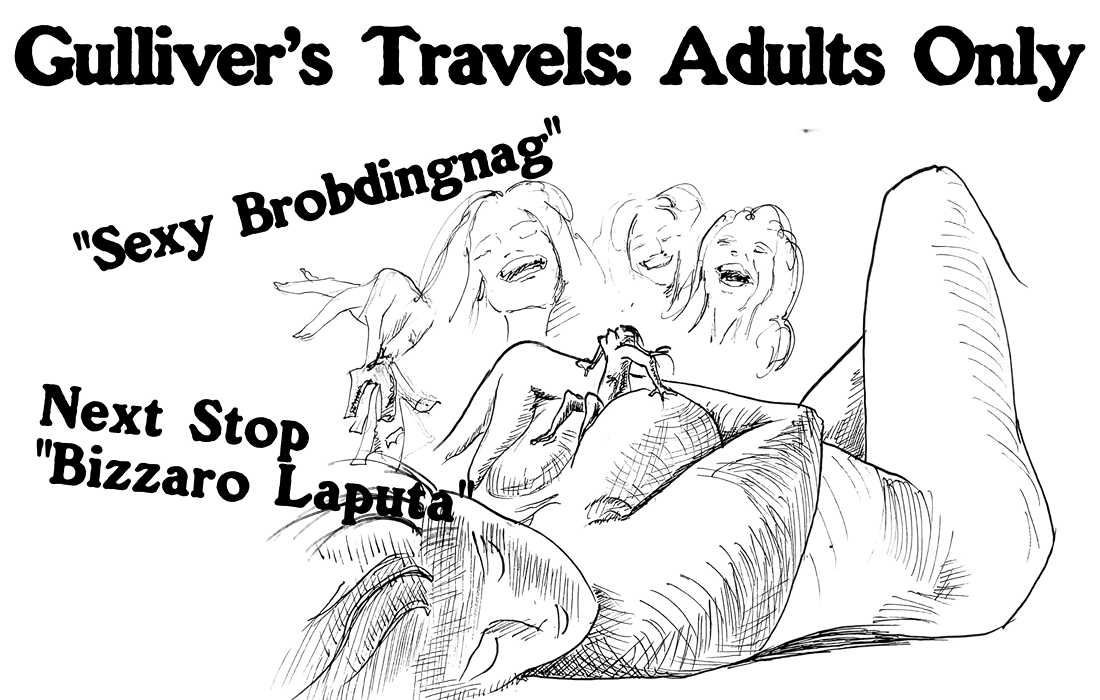
Today is the 300th anniversary of the publication of Gulliver’s Travels, written by Anglo-Irish Jonathan Swift. Everyone knows the first adventure of the giant on an island of tiny people, but that’s a fraction of Swift’s book which was most definitely written for adults. Here are five reasons you should read the book.
Gulliver’s Travels: The greatest satire by Jonathan Swift
Jonathan Swift (1667-1745) was the greatest prose satirist. EVER! (Sit down Voltaire, Twain and Orwell.) That means he wrote in everyday, non-poetic language to make fun of and expose society and the world around him. In fact, Gulliver’s Travels is just that – an examination and exposé of the vice and corruption of human society and government. Don’t be put off by that ‘heavy’ description. Gulliver’s Travels is highly readable and entertaining and full of vulgar content that we so readily watch, listen to and read about on social media today.
Why read Gulliver’s Travels? Five reasons
Here are my five reasons why you should read Gulliver’s Travels.
You can read the full text free online at Project Gutenberg.
- It’s downright funny. (It’s rude, too. We all like that kind of stuff). See my table of examples below.
- It’s highly imaginative . Swift’s imagination is marvellous to experience on the page and very entertaining.
- It will make you look at everyday society differently: The shrinking, magnifying and twisting of human experience is so clever it holds a mirror up for you to examine yourself, others and society.
- It offers deep perspective on the human condition: The Struldbrugs chapter, especially, gives new perspectives on aging and death. (Look, when you get into your 50s that becomes a thing.)
- It may turn you on to 18th century literature and history: Learning about these topics is fulfilling, highly addictive and life changing.
Who was Jonathan Swift?
He was an Anglo-Irishman who spent years living in London, then in 1713 took the job as Dean of St Patrick’s Cathedral, Dublin. He gave us great works such as A Tale of a Tub (1704), The Battle of the Books (1704), A Modest Proposal (1729) and, of course, Gulliver’s Travels (1726), published when Swift was 58 years of age and living in Ireland.
Summary of Gulliver’s Travels
The book describes the overseas journeys of ship’s surgeon Lemuel Gulliver who makes four voyages, each ending somewhere stranger. In one place he’s an enormous giant, after that he’s tiny and surrounded by giants, he visits a flying island, and the land underneath, he meets scientists, immortals, civilised horses and beast-like human Yahoos. After each location he makes his way back home to England. And then yep, he keeps setting off on another adventure. Swift uses the voyages to satirise politics, science, vanity and humanity itself.
Most of us know this story from films, TV and books. But mostly we’re getting the child’s version of the story, that is the tale of Gulliver’s visits to Lilliput and Brobdingnag. Those two lands are so visually arresting. It’s great fun to imagine being a giant or surrounded by giants. That’s good learning for a child’s brain. Lean over and ask the person on the bus next to you and I bet they don’t know the rest of the book, Gulliver’s final two journeys. Even most of the Gulliver movies, though the 1996 Ted Danson TV miniseries Gulliver’s Travels does cover all four voyages.
The lands Gulliver visits, and the rudest scene in each
| No. | Lands Visited by Gulliver | Example of his Experiences |
|---|---|---|
| 1 | Lilliput Island of tiny people, six inches tall, where Gulliver is a giant. | Eg. Gulliver puts out a fire in the empress’s apartment by urinating on it (and plenty of other toilet, sex and bodily observations). |
| 2 | Brobdingnag Land of giants, where Gulliver is the tiny one. | Eg. The queen’s maids of honour strip the tiny Gulliver naked and play with him, ahem (and lots of other ‘interesting’ observations). |
| 3 | Laputa A flying island of mathematicians and astronomers. | Eg. Laputans are absent-minded, so servants strike the mouths and ears with inflated bladders to remind them to speak or listen. |
| 4 | Balnibarbi Ruined mainland beneath flying island Laputa | Eg. One man’s job is to reduce human poop to the original food, including removing the colour, odour and any saliva. |
| 5 | Glubbdubdrib Island of sorcerers who summon the dead. | Eg. Summoned from the dead, Homer and Aristotle have never heard of their commentators and think them dunces |
| 6 | Luggnagg Kingdom and home to the Struldbrugs, who never die. | Eg. Gulliver first fantasises about immortality, then meets the immortals, who age forever without ever dying. |
| 7 | Japan Closed empire where Dutch are the only Europeans allowed. | Eg. Posing as a Dutchman, Gulliver asks the emperor to excuse him from trampling the crucifix, and the emperor is surprised. |
| 8 | Houyhnhnmland Land where horses rule over Yahoos (human beasts). | Eg. The leader of the human-beast Yahoos selects a favourite whose job is to lick his feet and bottom and bring him female Yahoos. [Read more in my post on the Houyhnhnms.] |
| 9 | England Gulliver’s home country. | Eg. Finally settled in England, Gulliver’s revolted by his family and all humans and spends hours talking to horses in his stable. |
Leave a Reply