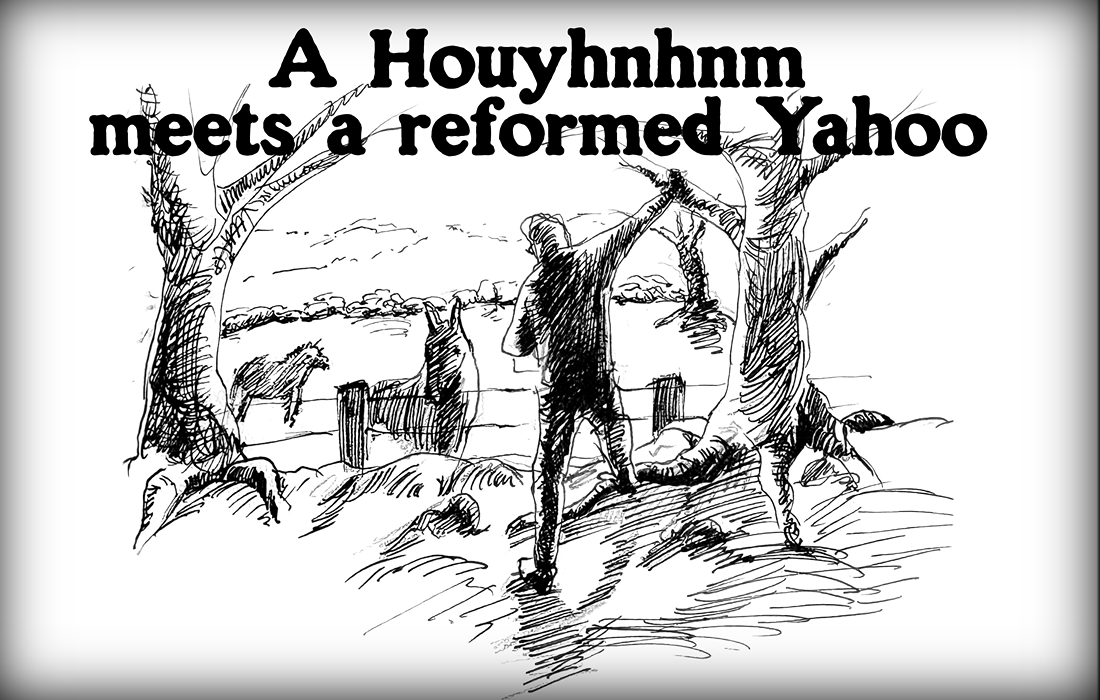
In this 300th anniversary post of Jonathan Swift’s Gulliver’s Travels I pay my respects to the Houyhnhnms who live in a ‘hidden’ field by my village. If you’ve never read the book…do yourself a favour: Read it beyond Lilliput. There’s an amazing world of imagination and many funny, rude and thought-provoking scenes.
Look out for my general post about Gulliver’s Travels coming up on the anniversary date of the publication of the book: 28 October, 1776.
The hidden field and the Houyhnhnms
For more than eight years I’ve been dog walking round and about our village, and I’ll always pause for five minutes at the hidden field. How to find it: walk across parkland, along a hundred yards of rabbit track, between a reed bed and a belt of birch, hawthorn and bay willows, then sidestep a break of trees which conceals the field. You’ll know it when you see clusters of big red toadstools. If you know where to step you’ll find a gap between trunks to the left and right, and through the canopy of leaves above and the burrowed out bank of exposed tree roots below, that’s where you’ll see it.
The only people who know about the field are me, the farmer, all the other dog walkers and the many delinquents who hang about to set fires, drink fortified wine, smoke weed, drop their litter and fool around. Often in the field there are sheep, occasionally cattle, or it might be empty, but sometimes there will be one or two Houyhnhnms.
The Houyhnhnms in Gulliver’s Travels
The Houyhnhnms are a society of horses occupying one of the many strange lands that feature in the enormously entertaining book, Gulliver’s Travels (published 1726). Every human being on this planet knows about the fella in the olden days that’s shipwrecked on an island of tiny people (Lilliput) where he’s a giant and then on another voyage visits a land where he’s the tiny one and everyone else is giant (Brobdingnag).
This is the work of the 18th century Irishman and master-satirist, Jonathan Swift (1667-1745). The full title of the book (it’s the 18th century…of course the title is a mile long) is Travels into Several Remote Nations of the World. In Four Parts. By Lemuel Gulliver, First a Surgeon, and then a Captain of Several Ships. The title hints that Gulliver visits more places, but the land of Houyhnhnms is the last before he returns to England and his retirement.
How do you pronounce Houyhnhnms?
“The name [Houyhnhnm] should be pronounced “whinnim”,” says academic and biographer Leo Damrosch, author of Jonathan Swift: His life and his world. It’s something like the whinnying sound a horse makes. I had no idea how to say the word when I first read the book back in 1996. But Damrosch quotes mid-20th century author Terence Hanbury White who makes his own attempt at explaining how to say the word. He says Swift meant the ‘hou’ to mimic the horse huffing and then “…and a Y for the squealy part, and the N’s and M’s are the part in the nose, Houyhnhnm. It is what a horse says.”
Where was the land of the Houyhnhnms?
Swift tells us a t the start of Part 4 that he takes up the position as captain of the 350 ton merchantman Adventurer, with a crew of 50. He leaves his wife and family behind and sets sail from Portsmouth on 7 August, 1710. His orders are to make discoveries and trade with the Indians in the South Sea. The text tells us they sail across the Atlantic to the Caribbean, many die of tropical disease and replacements turn out to be former buccaneers (not a good thing). They mutiny and replace Gulliver with one of their own as captain with the intention of sailing to Madagascar (so, turning east and sailing back across the Atlantic to go round the southern tip of Africa).
This is a proper adventure, right?! On the 9 May, 1711, after weeks confined to his cabin, the crew rows Gulliver to a nearby island, set him down, marooned and then sail off. Taking together all the evidence Swift gives in his story, before Gulliver’s abandoned and when he leaves and is rescued…that puts Houyhnhnmland off the south west coast of Australia, an island in the south eastern Indian Ocean. Gulliver embarks on the journey back to England on 15 February, 1715 (1714–15 in the old-style calendar). He spent years among the Houyhnhnms.
Gulliver, the Houyhnhnms and the Yahoos
I won’t give the story away, but the first discovery Gulliver makes is of the Yahoos, human-like creatures, covered in hair, who behave like the most basic animals. Yes, Jonathan Swift gave the English language the word Yahoo. (Remember the Yahoo! The internet portal, email provider etc of the mid 1990s? It’s the same word. And No, ‘Yahoo’ does not appear in Samuel Johnson’s 1755 dictionary.) Gulliver describes his first encounter with the natives.
Meet the Yahoos
Some of them coming forward near the place where I lay, gave me an opportunity of distinctly marking their form. Their heads and breasts were covered with a thick hair, some frizzled, and others lank; they had beards like goats, and a long ridge of hair down their backs, and the fore parts of their legs and feet; but the rest of their bodies was bare, so that I might see their skins, which were of a brown buff colour. They had no tails, nor any hair at all on their buttocks, except about the anus, which, I presume, nature had placed there to defend them as they sat on the ground…
Gulliver then sees a horse enter the scene and the Yahoos he had been observing scatter in fear. The horse then approaches him.
Meet a Houyhnhnm
The horse started a little, when he came near me, but soon recovering himself, looked full in my face with manifest tokens of wonder; he viewed my hands and feet, walking round me several times. I would have pursued my journey, but he placed himself directly in the way, yet looking with a very mild aspect, never offering the least violence. We stood gazing at each other for some time; at last I took the boldness to reach my hand towards his neck with a design to stroke it, using the common style and whistle of jockeys, when they are going to handle a strange horse. But this animal seemed to receive my civilities with disdain, shook his head, and bent his brows, softly raising up his right fore-foot to remove my hand. Then he neighed three or four times, but in so different a cadence, that I almost began to think he was speaking to himself, in some language of his own.
And this is where the story of the Houyhnhnms and the Yahoos unfolds. The Yahoos (that’s us, the humans, in this satire. I didn’t need to point that out, I’m sure.) are filthy, greedy, selfish, brutish – all the characteristics educated people in Britain possessed and despised. The Houyhnhnms on the other hand, badly treated, used as beasts of burden, killed for meat etc by the humans in Britain, had on this island attained refined manners, conversation and composure to which humans aspired. The roles between human and horse, were thus reversed on the island among the Houyhnhnms and Yahoos.
Meeting the Houyhnhnm in the hidden field
After six years working from home, losing the benefits of meeting and conversing with fellow humans face to face, and all the activity that goes with that (washing, clipping toenails, brushing teeth, shaving, ironing clothes, speaking politely, asking people about themselves and so on)…after six years of that I had become something of a 21st century Yahoo. That would explain why the horses (Houyhnhnms) never approached me when I saw them in the hidden field.
But after a couple of weeks during which I came apart at the seams, I’ve been picking up and rediscovering all those old habits of hygiene, personal conduct, responsibility and social interaction. I feel like I’ve left behind the Yahoo I became – after Covid sent us all home to work – and maybe the Houyhnhnm I saw in the hidden field the other day recognised that as he mosied over to the fence for a closer look; not a conversation, just a cautious reconnoitre.
I didn’t make the parallel with Swift’s Gulliver satire until a couple of days after seeing the horse. But then I remembered it’s the 300th anniversary of the publication of his most famous and enduring work. The mighty, the funny, the clever, the readable Gulliver’s Travels.
Notes
Gulliver’s Travels, Jonathan Swift (1726) – I don’t have a copy and so referred to a free online version here.
Jonathan Swift: His life and his world, Leo Damrosch (2013)
Leave a Reply