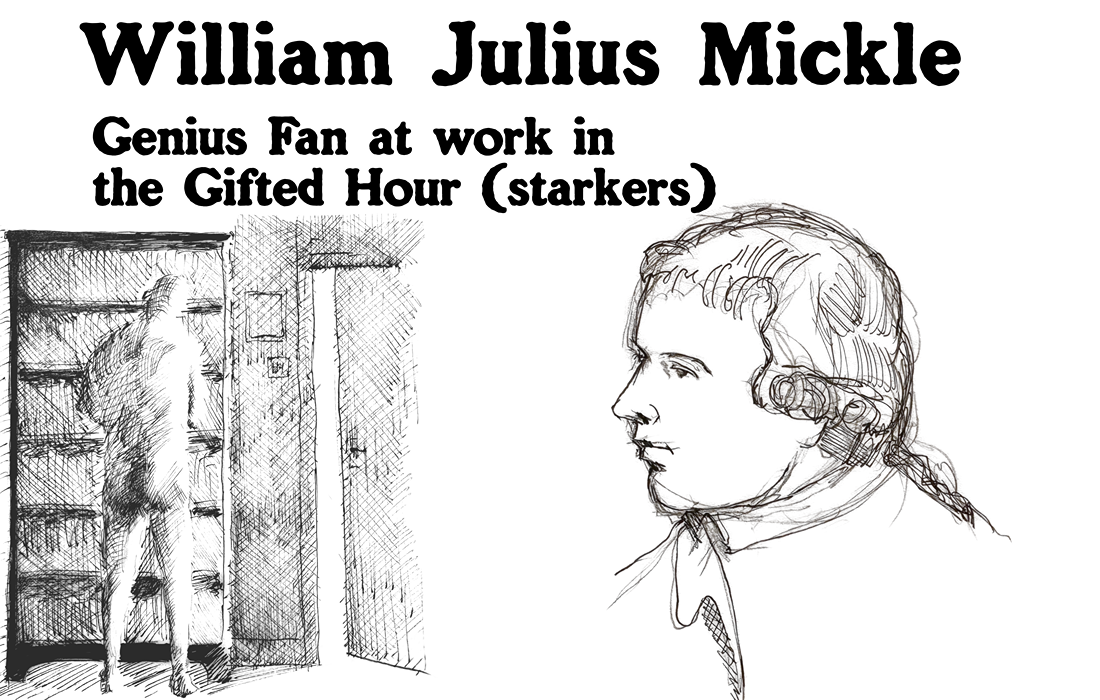
On a stormy night when the clocks went back an hour, the Genius Fan discovers Scots poet and translator William Julius Mickle. And it turns out he was a friend of James Boswell. A good night’s research, I think.
01.45:00 Storm Boelo sets me up for poet William Julius Mickle
It was a quarter to two, early on Sunday morning. For most of the previous day Storm Boelo had barrelled round Scotland’s towns and countryside picking up trampolines and slamming them into neighbours’ gardens. It was cold and the central heating came on at 1am. I woke up parched and with a naughty little headache. Outside storm Boelo was roaring and inside I was naked (it’s how sleep) padding to the kitchen, guided by my mobile phone torch.
01.50:00 Headache, tea, and Leask’s biography of Boswell
I saw ten to two on the dining room clock. I needed headache tablets, and of course I needed a cup of tea to help me swallow the tablets, and of course I needed a book to read while drinking my tea, and of course a book had dropped through the letter box just twelve hours previously: W Keith Leask’s biography James Boswell (1896) 1. This book has been in and out of my online shopping carts for years. It seemed like if I was going to bring another book into the house it should be on a topic new to me. But it’s about Boswell so it was always gonna get itself bought.
01.55:00 Finding Mickle in Leask’s 19th century prose
Now the clock read five to two in the morning. I opened the cover and turned the pages of Leask’s book and slowly my headache disappeared as I set to disentangling the subjects and clauses on the page. Then I read the following passage in a section about Boswell never missing an opportunity to brag about his lineage:
…we find him alluding in a letter of 10th May, 1786, now before us, to Mickle, the translator of the Lusiad…’
[My understanding: Boswell apparently knew someone called Mickle who had translated something called the Lusiad.]
01.59:50 The Gifted Hour begins my research
It was almost two in the morning. I didn’t recall coming across this fellow in my reading. So, I went to my book case to see what I could find. He pops up in some volumes (and not in others), for example:
- Scottish Men of Letters in the Eighteenth Century, Henry Grey Graham (1906)
- The History of Scottish Literature, Volume 2: 1660-1800, (ed) Andrew Hook (1987)
- The Enlightenment and the Book: Scottish Authors and Their Publishers in Eighteenth-Century Britain, Ireland, and America, Richard B Sher (2006)
I pulled together the basics about Mickle from these books. William Julius Mickle (1734/5-1788), born in Langholm, Dumfriesshire, near to the border with England. He moved to England to pursue a career in writing, changed his name from the Scottish-sounding Meikle to the less-Scottish-sounding Mickle, and added the name Julius in the middle for good measure…and his masterpiece seems to have been a translation of the epic poem Os Lusíadas (1572) by Luís de Camões, a 16th century Portuguese poet.
Next: online I discover a whole lot more about him. His Os Lusíadas translation was a big deal, apparently, and while Mickle was visiting Portugal in 1779, the king treated him like a celebrity. His famous ballad, Cumnor Hall, inspired Sir Walter Scott’s novel Kenilworth.
Who wrote ‘There’s Nae Luck about the House’?
Was it Mickle or Scots poet Jean Adam? There’s debate over whether Mickle wrote the well-known song, “There’s nae luck about the House“. It’s a wonderfully simple song about a sailor’s wife who’s just heard her husband’s returned from sea. She says there’s no pleasure in the house while her husband’s away. (Read the poem on the Scottish Country Dancing Dictionary.) The Oxford Dictionary of National Biography (ODNB) quotes Robert Burns saying the poem is: “…one of the most beautiful songs in the Scots, or any other language.” (ODNB quotes R. H. Cromek, ed., Select Scotish songs, ancient and modern, 2 vols. (1810), 1.67–70.)
JJ Caudle’s ODNB entry for Mickle doesn’t mention the poem. You would think it would mention it if Mickle were the author. The ballad is mentioned in the ODNB for Jean Adam(s) (1704-1765), a poet from near Greenock on the west of Scotland, and author of Miscellany Poems published in 1734 (published under her anglicised name Jane Adams (ODNB)). The reference says this is the poem for which Jean Adam is best known (that’s still not definitive; being best known for something doesn’t mean that person is the author.) And the internet’s unclear, of course. Mickle’s Wikipedia entry suggests it’s been decided in his favour. The Traditional Tune Archive suggests that Mickle’s wife found the words of the song written down in his notes. I’ve got no conclusion on this debate.
Did William Julius Mickle meet James Boswell?
Of course Mickle met James Boswell! They were contemporaries after all – Mickle was born five or six years (birth date uncertain) before Boswell. I dug into my copy of The Life of Samuel Johnson (Folio Society, 1993 printing) and found the following references.
| Occasions when Mickle appears in Boswell’s Life of Johnson |
|---|
| Vol 1: Early April 1772 (p.418) Boswell appears to have been quite well-acquainted with Mickle and the pair paid a visit to Oliver Goldsmith at his new lodgings one day. |
| Mr Mickle, the translator of ‘The Lusiad’, and I, went to visit him at this place… He was not at home; but having a curiosity to see his apartment, we went in and found curious scraps of descriptions of animals, scrawled upon the walls with a black lead pencil. |
| Vol 2: Thursday 11 April 1776 (p.73) |
| We spent the evening at Mr Hoole’s. Mr Mickle the excellent translator of ‘The Lusiad’, was there. |
| Vol 2: Undated letter, quoted in the Life at 1783 (p.487) [Boswell was writing after Mickle’s death in 1788, hence ‘the late ingenious Mr Mickle’.] |
| The late ingenious Mr Mickle, some time before his death, wrote me a letter concerning Dr Johnson, in which he mentions, “I was upwards of twelve years acquainted with him…I never received from him one rough word.” |
| Vol 2: Summer 1784 (p.526) |
| On Monday 14, and Tuesday, June 15, Dr Johnson and I dined on one of them, I forget which, with Mr Mickle, translator of the ‘Lusiad’, at [his home in] Wheatley. |
01.00:01 An hour spent in books – the Gifted Hour
After all my work between bookcase and dining room table I packed up my volumes, rinsed my cup and right there, the clocks went back to one o’clock in the morning. Again!
If you’re into books and literary history every spare hour you can get is like gold. When else do we get sixty minutes for free, to bury our nose in books and follow the leads? I’ll forever associate Mickle with my 2026 Gifted Hour – one only gets one per year, after all – and I’ve since started looking up Mickle’s name in the index of all my Yale Boswell Journals. And he’s there.
(We do have to pay for that hour, in reality. I didn’t get to sleep for another hour, so busy was I piecing together the story in my head about Mickle and Boswell, that come morning time – storm Boelo still flexing its muscles – I was pretty tired and had to nap. A small price to pay.)
Notes
1 Author William Keith Leask (1857-1925) writes an interesting book and if you like your prose loaded with clauses and entwined with obscure references, then you’ll like this. Leask was born and educated in Aberdeen. He studied at Oxford, returned to lecture at Aberdeen university, then in Oxford, then back to Aberdeen for the remaining three decades of his life. He also authored the Famous Scots Series volume about geologist Hugh Miller.
This book is part of the ‘Famous Scots Series’, published by Oliphant Anderson and Ferrier (Edinburgh and London). This series, Wikipedia tells me, has 42 volumes and when I turn the first two pages of my volume, a short list announces a number of other titles in the series, including Thomas Carlyle, Allan Ramsay and Robert Burns. The volume has a nice dedication, meaningful to Boswellians and Johnsonians, alike. It reads:
To
George Birkbeck Hill, D.C.L.;
MA Pembroke (Johnson’s) College, Oxford;
Chief of Johnson scholars and editors;
And himself most “clubable” * of men.
* Leask applies this word ‘clubable’ to Hill, and of course, all Boswellians know Johnson created the word for Boswell. It’s often used in biographies and descriptions of our cherished biographer. For those who are interested: I tracked it down in my Folio Society copy of Boswell’s Life of Johnson: (I know. But we can’t all have the Birkbeck Hill scholarly edition. Revised and enlarged by L. F. Powell. 6 vols. Oxford: Clarendon Press, 1934–50.)
Life of Johnson (Folio Society, 1993 printing, Vol.2, p.490, * note)
I was in Scotland when this Club was founded, and during all the winter. Johnson, however, declared I should be a member, and invented a word upon the occasion: ‘Boswell (said he) is a very clubable man.’
Nov-Dec 1783
Finally, inside my edition I found an original book mark, listing further volumes in the Famous Scots Series (The Balladists, John Knox, Sir Walter Scott, The Blackwood Group, and others).
Leave a Reply