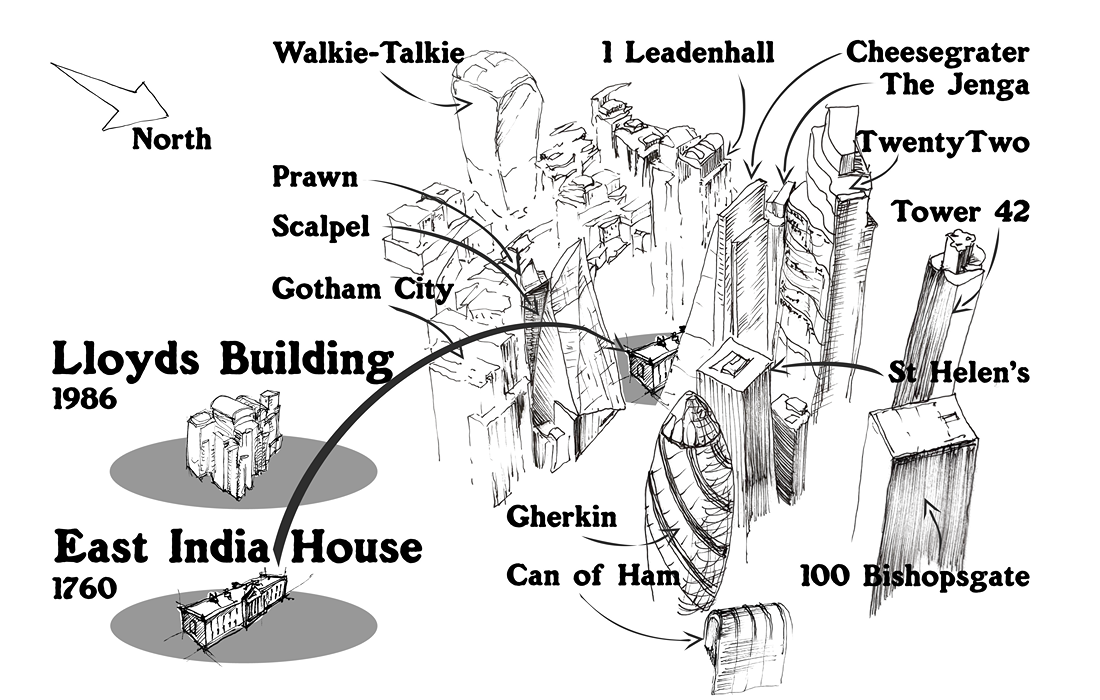
My work sent me to London again. So of course, I squeezed in a secret trip back in time to the Eighteenth century. My HQ in London’s City square mile is surrounded by all the old streets and stomping grounds of James Boswell and Samuel Johnson’s age, so I always have an embarrassment of choice over what to visit. And since I keep my identity as the Genius Fan secret from colleagues, in much the same way that Batman is Bruce Wayne to everyone he knows, I have to find a way to sneak off on my own.
Exploring 18th century London while I’m ill
I was genuinely ill that day, but you know, the show has to go on, so I staggered into the shower at 0345, fell into the taxi at 0415, boarded the plane at 0700, landed at 0840, flopped onto the Docklands Light Railway at 0910 and swiped through the front door of our office (just off Leadenhall) at 0950. I’ve studied my diary and worked out a cover story for disappearing that will give me 45 minutes on my own. (To be honest the Eighteenth century ‘stuff’ is all on my doorstep so I could do a visit in under 5 minutes.) Here it goes: At 1130 I feel a coughing fit coming on and make my excuses and leave. Out to the 9th floor lifts, down to the Ground floor and into the fresh air.
I whip out my phone, and type in the postcode for the old East India House, former HQ of the East India Company. It’s long ago demolished, but there’s enough on the internet to help guide me to its former location. I hadn’t planned on my GPS being so flippin’ hopeless, it must be the skyscrapers towering over me: the Gherkin, the Walkie-Talkie, the Cheesegrater, the Scalpel, the Prawn, the Jenga. So what should have been a 40 second walk to the postcode EC3M 7HA, turned out to be a 20 minute walk, criss-crossing this few square metres of the City of London, all the while coughing, blowing my dose, and of course, sweating.
East India House, the HQ of the East India Company
When you study Eighteenth history (that’s structured learning, rather than reading for pleasure and discovery), the East India Company is one of the topics you’ll learn about. Since its foundation in 1600, it was a trading company importing spices and textiles from India. By the second half of the Eighteenth century it had shifted from trade to conquest and became a quasi-sovereign power with its own private army taking control of most of the Indian subcontinent. It levied taxes, administered justice and ran a civil service – all while being a profit-driven corporation answerable to shareholders in London.
And all that power – this was one of the largest corporations in history – was controlled from East India House. This was the HQ of the East India Company. At first it was all trade records, shipping, import and so on, and then it housed the records for the civil service and private army etc that grew up to run the subcontinent. That building would have been a hugely busy place, people turning up for work every day, directors, managers, clerks, lawyers and so on. having meetings, going for lunch, taking breaks, making their way home. Hustle. The building itself grew and upgraded and evolved as the company expanded and became more powerful, especially in the Eighteenth century. The British Government took control of running India in 1858 and the building was demolished in 1861-2.
How to find East India House
As enjoyable as it is to wander around the City of London at noon on a beautiful day, surrounded by coffee drinkers, smokers, vapers, people on mobile phones, couriers, tourists, construction workers (they’re everywhere) and dare I say it, business men and women…it’s a difficult place to orient yourself. It’s not like normal streets. There’s so much glass and steel, a mix of road and pedestrian zones, streets passing under buildings like huge tunnels, you forget where you’re facing. If in doubt, ask a security guard.
I found a fellow in black standing guard outside an office entrance. He obviously knew the history of the area. He nodded and glad for the opportunity to help, he said, “It’s all here, under our feet. The front of the building was just up there round the corner on Leadenhall.” I was on Lime Street. “It stretched from the front of the building all the way back. This,” he said with outstretched arms, “…would have been warehouses and then going all the way back down Lime Street.”
I asked if there was a blue plaque or an information board, and he suggested it had all been taken down, “Y’know, because of the…” and his voice trailed off as we both understood what he didn’t need to say. In other words, you can’t point out a historical fact without couching it in anti-racist terms referencing the politics of colonialisation and empire. Why would the owner of a building put up a sign to highlight this was the site of the East India Company HQ? It’s inviting discussion and disapproval, debate and bad press. Nobody wants that. (I searched online, and I can’t find any evidence that there has been a plaque indicating the site of East India House.)
So, where is East India House?
East India House, no longer exists. It stood on Leadenhall Street, the foundations of the current Lloyd’s of London building, commonly known as the Inside-Out Building. That’s where the impressive colonnade frontage stood on Leadenhall, opposite the modern day Cheesegrater, the 225m tall skyscraper at 122 Leadenhall Street. If it was still standing today, it would be dwarfed by all the City of London’s skyscrapers. You have to cross Leadenhall Street to a street named St Mary Axe (! I know) and look back to the Lloyd’s of London building to see down Leadenhall towards Bishopsgate to get a good view.
From there you can stand and imagine, the Eighteenth century traffic. Horses, carriages, chairmen, pedestrians, errand boys, the whole world of imperial commerce and its local supply chain. If you see someone, standing motionless and looking in that direction, eyes staring in the distance…that’s what they’re doing: seeing the grandeur of the time. And in their mind’s eye hoping to catch a glimpse of Robert Clive entering, Warren Hastings emerging, Edmund Burke, William Pitt the Younger, Lord Cornwallis, Richard Wellesley and so many more.
Don’t forget, I’m ill
And then, right on cue, another coughing fit hits, headache on its way…and in 90 minutes I have to deliver a presentation. My 45 minutes are up, my cover story has an expiry date, and I have to find my way back to my office. It’s literally 40 seconds away. My office is nine floors up and overlooks the site of the old East India Company HQ. You can’t move in London for the Eighteenth century. It’s everywhere.
Leave a Reply