This post is more of an anecdote – albeit Eighteenth century-related. And it’s dedicated to the readers from China who have been visiting the Genius Fan website a lot over the past fortnight. (My website analytics show only the country of visitors, not the city). My story features Scotland’s national bard, Robert Burns, an Eighteenth century poet I believe many Chinese are familiar with.
Local legends of Robert Burns
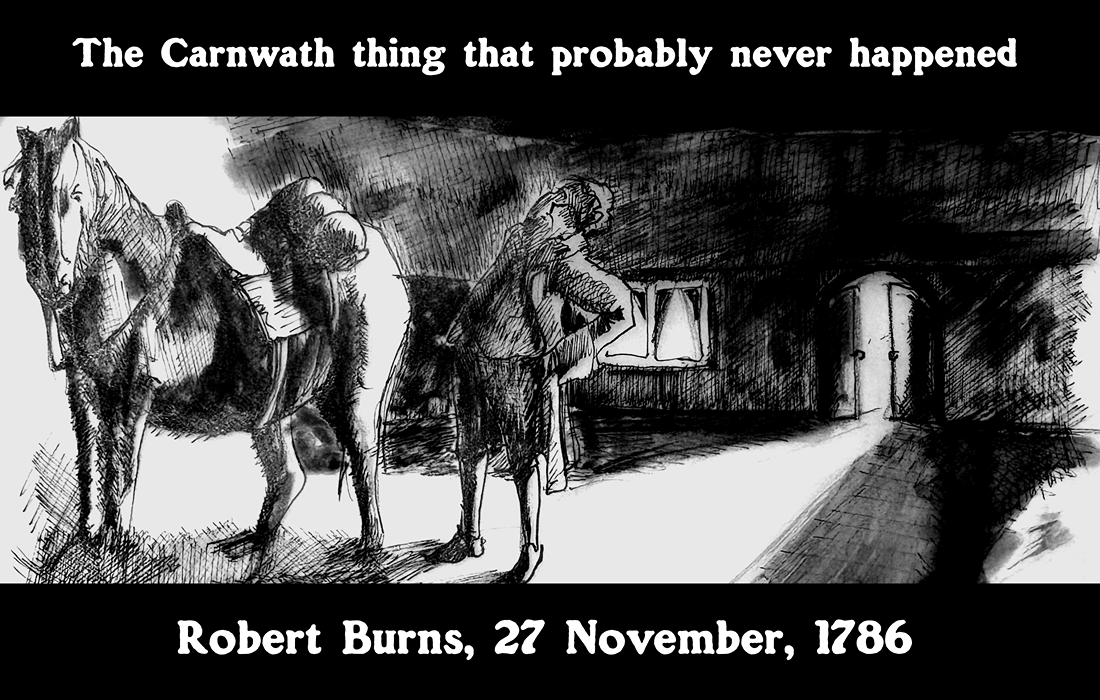
There I was, barrelling through the Scottish countryside on a scorching and turbulent summer’s afternoon. I was heading south west and about to reach the village of Carnwath – a route I knew well from having driven a lot back in the late 20-teens. Now, I’m always alert to the possibility of an Eighteenth century diversion, and I remembered there was a folk tale about Carnwath and how Robert Burns stopped off at the village on his way from Ayrshire to Edinburgh. This would be Burns’ first visit to the big city, and it promised good fortune following the recent success of his book, Poems, Chiefly in the Scottish Dialect. It was 27 November, 1786.
What does local folklore tell us about a Burns visit? The stories I’d read in books, papers and the internet start with him having a great night when he stopped off at a house at Covington Mains nearby to Carnwath. Other stories say he stopped off in the village itself and visited the Wee Bush pub, where he may have etched his name into a window pane, and the bank building. I thought I’d relive my old days as a junior reporter in the Buckinghamshire Chilterns: Park up, dive into a local shop, meet some locals, charm them, ask directions and pick up some gossip. That was my June 1991.
I use reporter’s tricks to find local knowledge
I darted into Carnwath Post Office & Shop and said I was looking for some local information. The two shop assistants stiffened slightly. I said “Robert Burns,” and the woman tidying greetings cards relaxed. They gave me as much as they could, though neither knew the Burns connection. The Wee Bush pub is gone, says one, it burned down, but the building’s still there. They described its location, told me to ask in the Mason’s Arms pub, I thanked them and left (without purchasing a chocolate bar – I have to say that…my wife may read this post). Out in the street, amidst the din of the lorries idling at the traffic lights, I make my way north east along Main Street, looking for the “building that sticks out in the street.” (I’ve been here before, getting into the Eighteenth century groove.)
And there it is, just as described. The building formerly known as the old Wee Bush pub, now a pretty little, whitewashed home. I walk around it doing the old reporter’s ‘draw attention to yourself’ trick (someone inevitably comes over and blurts, “What the **** are you doing?” And that stimulates a conversation, yielding more information.) Not today though. No-one cares about my unplanned research. I search for a plaque. Of course, there isn’t one. I snap my photos and cross the road to the Mason’s Arms pub. Flashback: It was 1992 and I went into a Buckinghamshire pub for comments about the death of a young motorcyclist. I got huckled, knocked off my feet, crawled across the floor, but dragged outside to safety by a friend of the dead biker.
That was then, this is Friday 26 June 2026, I’m cleverer now. I side step a youngish drunk sitting in the doorway chatting to passers by and push through the door to the pub. Same routine: I’m looking for some local information. I say “Robert Burns,” and the indifferent bar tender and cautious-bloke-with-pint warm up. The boozer tells me he knows the Wee Bush: “Brilliant place. Used to stay opposite it. Lots of great nights in there. They did steaks on sizzler plates.” But they don’t know the Robert Burns connection. “It was the last pub in Scotland with a thatched roof,” says the fella. He uses the maps app on my mobile to give directions to an area called Covington, nearby to a locality called Quothquan. It’s too far out of my way…I gotta get home. His phone rings and I make my excuses and leave.
Still need to peel back more layers to find Burns in Carnwath
Let’s look at the Burns biography I have on my bookshelf. It’s Dirt & Deity: A Life of Robert Burns by Ian McIntyre. At the very end of Chapter 5 the author reminds us this journey is a big deal for the 27-year-old poet whose life up to this point had been Ayrshire: “…Burns pointed the beast’s head eastwards and rode for the first time beyond the boundaries of those native districts and counties.” Turn the page for the opening of Chapter 6. McIntyre tells us Burns’ overnight was near Biggar, a village eight miles south east of Carnwath…at a farm called…wait for it…Covington Mains! On a map I can see Covington Mains appears to be about half way between Biggar and Carnwath.
McIntyre cites an 1841 letter from Archibald Prentice, who appears to have been the son of the farmer from Covington Mains:
“…at length Burns arrived, mounted on a pownie…Instantly was the white flag hoisted, and as instantly were the farmers seen issuing from their houses, and converging to the point of meeting. A glorious evening, or rather night, which borrowed something from the morning, followed…”
So, it seems the place I didn’t visit has some evidence backing it up as a location visited by Burns (Covington Mains)…but the place I did visit (the Wee Bush pub) got no mention. (I had also walked past the bank, which I had read somewhere may have been a place Burns visited.) This doesn’t mean Burns didn’t stop in at Carnwath, just makes it less likely.
Local folklore
In 2025 I stopped off in Laurencekirk to search for the location of an inn visited, on separate occasions, by Burns and James Boswell, and then again the site of a hotel Boswell and Samuel Johnson occupied in Montrose, and I came away satisfied I had the place: there were commemorative plaques on the buildings, so it must have been true. (Ahem.) But I believe the Burns-in-Carnwath sites were all guesses. No plaques. The more widely one reads the more likely one is to come across these little pieces of lore and what’s the harm in following them up. Some people in Carnwath will know the Burns lore, I just didn’t meet them.
But I do get the sense of being on the hunt. When you put yourself out there, go into a pub and ask for information, people will talk to you (or they may knock you to the ground – depending on what you ask). Looking back 240 years by walking round a village in the sun makes this history journey all the more pleasurable. One of these days, someone will say: “I don’t know what you’re talking about, but did you know…” and tell me an even bigger story than anyone expected.
Read my post James Boswell met EVERYONE in the Eighteenth century, but not Scotland’s poet Robert Burns.
Notes
Dirt & Deity: A Life of Robert Burns, Ian McIntyre (1995)
Poems, Chiefly in the Scottish Dialect, Robert Burns (1786)
Leave a Reply