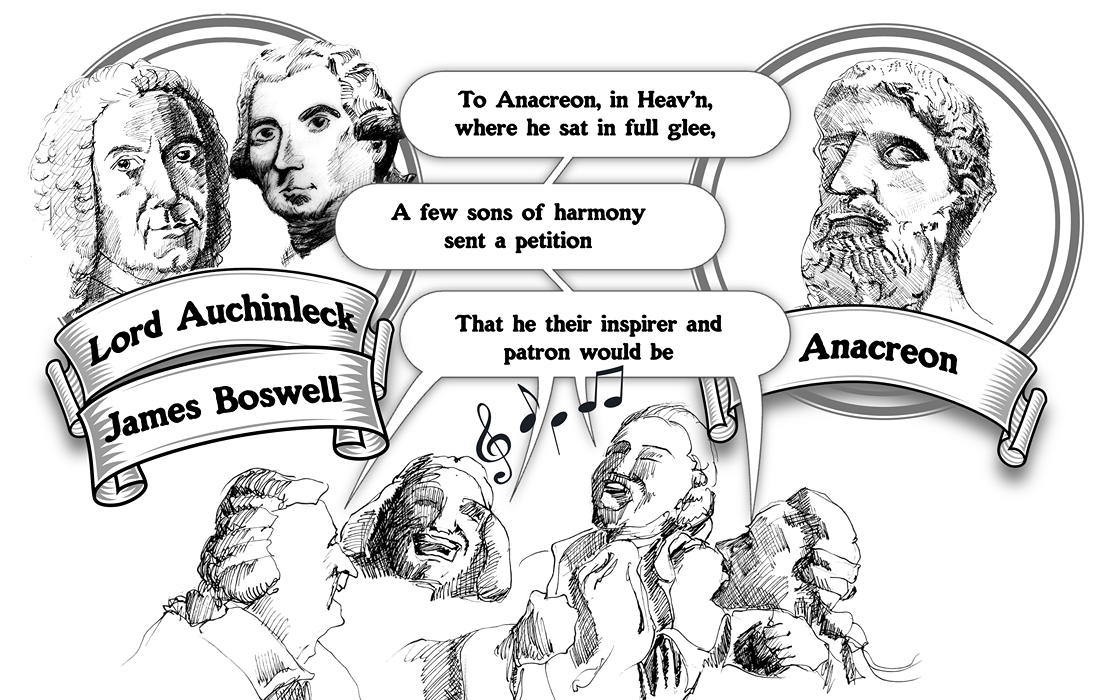
This is a story about an Eighteenth century English drinking song and how it brought together a stern Scottish judge and an ancient Greek poet. By the end of this post, you’ll understand why they belong together, but let’s start with a tune you already know.
The American national anthem was a drinking song
“The Star-Spangled Banner” is the national anthem of the United States of America, and it’s one of the most recognisable melodies around. What very few people know is that the tune began life as the ‘theme’ tune (also known as a constitutional song) of a London gentlemen’s club — a rousing, celebratory drinking number called “To Anacreon in Heaven.” You’re probably humming the tune in your head right now. So, so catchy. The connection with the anthem comes in the Nineteenth century: US lawyer Francis Scott Key wrote the lyrics after witnessing the British bombardment of Fort McHenry in September 1814. And when he needed a melody, he reached for a tune he already knew. That tune had been crossing the Atlantic for decades. It began in a London tavern. And it began with a Greek poet who had been dead for over two thousand years.
Who was Anacreon?
Anacreon (c. 573 – 495 BC) was a Greek lyric poet, born in Teos, on the western coast of Turkey. He was celebrated in his own lifetime and long after for his odes to wine, love and the pleasures of life. He was, to put it plainly, a poet who enjoyed himself enormously and saw no reason not to write about it. His verses are light, warm, and shot through with pleasure. (Read some them on the All Poetry website.) He lived to a remarkable old age — possibly into his eighties — which his admirers took as proof that his approach to life had something to recommend it. Yawn. “So what,” right? Wait for it…
The Anacreontic Society
Fast forward more than two thousand years (I know) to London, 1766 AD!. A group of gentlemen — barristers, doctors, professional men and music lovers — founded a club in his honour: the Anacreontic Society. They met at the Crown and Anchor Tavern on the Strand for evenings of music, dining and convivial entertainment. Their president Ralph Tomlinson took it upon himself to write the lyrics for a constitutional song, called appropriately, “To Anacreon in Heaven” and then another member, John Stafford Smith, himself a composer and musician, wrote the tune. It was published in 1778. (You can hear a modern rendition of the song on You Tube.)
So catchy was the tune – I know, it’s now an earworm playing over and over in your head…that over the coming years it travelled around the taverns of London and beyond, also finding its way to America. By the time Francis Scott Key pinched it for his poem in 1814, it was already well known on both sides of the Atlantic. The United States made it their national anthem in 1931. Anacreon, the pleasure-seeking Greek, had made it to the New World.
Now, the stern Scottish judge who loved Anacreon
Of course there’s a Boswell connection! One serious scholar and devoted student of Anacreon’s texts was Lord Auchinleck, Alexander Boswell, father of James Boswell. (Read about Boswell’s family here.) Auchinleck (1707-1782) had studied law at Leiden in the Netherlands, where he moved among the foremost classical scholars of Europe, and developed an interest in collating the texts and editions of Anacreon. The casual reader of James Boswell may be surprised to discover that his father was more than a crusty old Presbyterian, a dour Scottish judge and a father who was stern and not open to the ‘manners’ of which James was blessed by the barrel-load!
He spent nearly two years studying Law in Leiden in the late 1720s. There he met and made friends with Abraham Gronovius (1695–1775), part of the famous Gronovii dynasty of scholars. Gronovius was a classical scholar and became librarian at the university of Leiden and this is likely the connection which led to his interest in Anacreon. It’s also believed to be where Auchinleck found his copy of Anacreon by William Baxter, 1650-1723. Auchinleck’s copy of this book can be found in the Boswell collection at Yale University in the USA.
In his Journal of a Tour to the Hebrides, on Tuesday 2 November, 1773, (see my 250 year old copy of the book) Boswell describes how he and his companion, the great Samuel Johnson, arrived at his family estate, Auchinleck in Ayrshire. Rain prevented them from touring the grounds, so they stayed indoors and that’s where book lover Johnson made his strongest connection (and connections were few and far between) with his host, Lord Auchinleck. They were in Auchinleck’s library which Boswell stated was “not excelled by any private collection in Great Britain.” It seems rubbing shoulders with Classics scholars in Leiden had stayed with the older Boswell who used his wealth and influence to grow a substantial colleciton of books at Auchinleck.
Samuel Johnson prized Auchinleck’s copy of Anacreon
“He was a sound scholar, and, in particular, had collected manuscripts and different editions of Anacreon, and others of the Greek lyric poets, with great care; so that my friend and he had much matter for conversation, without touching on the fatal topics of conversation,” wrote Boswell for that date. He then describes how Johnson, browsing the volumes, discovered Baxter’s Anacreon, “which he told me he had long inquired for in vain, and began to suspect there was no such book.” Johnson relished that volume and one can imagine him taking it to his room at night to read and pore over Auchinleck’s notes.
Anacreon pops up in Boswell’s Life of Johnson, as one of the few Greek writers Johnson read while he was at Stourbridge in the mid-late 1720s. And in a letter to Boswell dated 31 August 1772 he prompts: “You promised to get me a little Pindar, and may add to it a little Anacreon.” Perhaps Boswell had already mentioned his father’s Anacreon interests. Johnson certainly read it during his visit to Auchinleck in November 1773. A decade later, before his death in December 1784, he remembered that very book and asked Boswell to bring it on his next visit to the capital. Lord Auchinleck had died in 1782, so Johnson may have calculated Boswell had ownership of it.
Boswell published another letter extract from Johnson in his Life of Johnson: “When you come hither, pray bring with you Baxter’s Anacreon. I cannot get that edition in London.” In another exchange of letters (in the Life of Johnson), Johnson responds, after admonishing Boswell for not writing sooner, says: “Your Anacreon is a very uncommon book; neither London nor Cambridge can supply a copy of that edition.” And yet another letter, this time in March 1784, he urges Boswell: “If you come hither through Edinburgh… Please to bring with you Baxter’s Anacreon.”
Conclusion
I read somewhere that Boswell and Johnson were both members of the Anacreontic Society (I need to keep a note of these things – it’s unverified – let’s leave it at that). If they attended one of the Society’s boozy evenings, I’m certain in my head Johnson would have pestered Boswell for his father’s copy Baxter’s Anacreon, a book which sits, like the Ark of the Covenant at the end of Raiders of the Lost Ark, in a box or on a shelf somewhere in the vaults of Yale University. This is a nice story of connections and following it is one way of opening your brain to history.
Notes
Journal of a Tour to the Hebrides, James Boswell (1785)
The Life of Samuel Johnson, LL.D., James Boswell (1791)
Leave a Reply