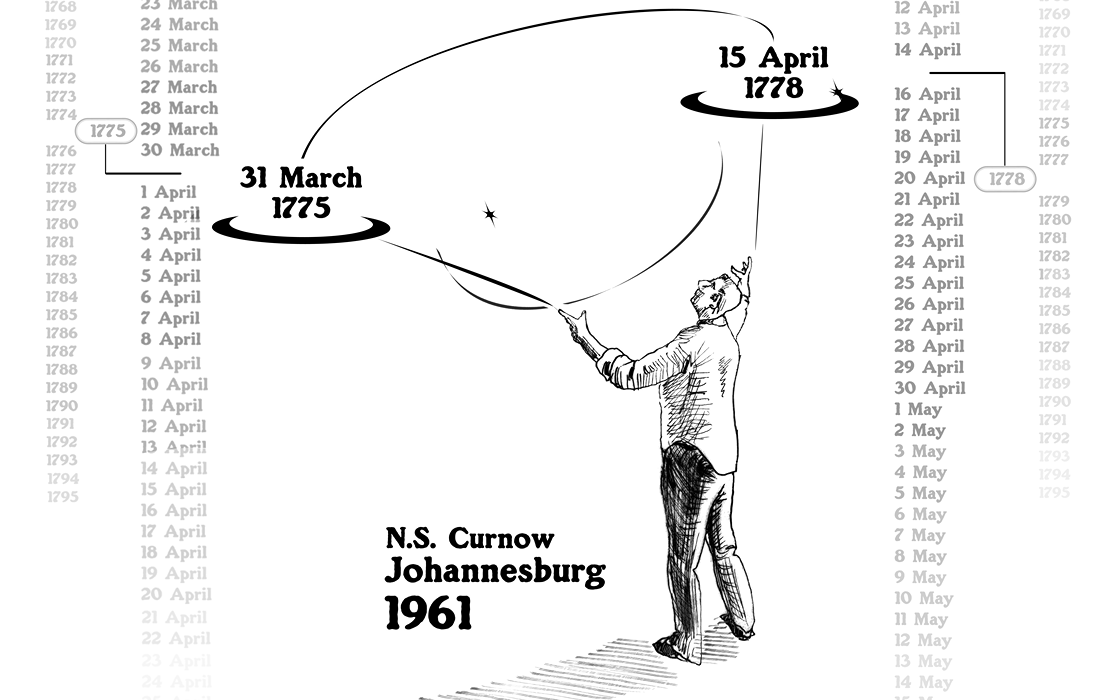
In his 1982 book Pride and Negligence: The History of the Boswell Papers, Yale Professor Frederick Pottle suddenly halts the narrative to describe the appearance, out of nowhere, of a Boswell superfan by the name of Stanley Curnow. He was a South African, living in Johannesburg, tax accounting by day and by night devouring everything about Eighteenth century history he could get his hands on. By way of his knowledge, enthusiasm and research skills Curnow became a part of the so-called ‘Boswell Factory’. But his time was short-lived and he disappeared as suddenly as he appeared. This is an interesting little story.
The busy Boswell Factory receives a letter from Johannesburg
We’re going back to autumn 1957. It’s Yale University in New Haven, Connecticut. The mail has plonked down in the office of Professor Frederick Pottle’s ‘Boswell factory’. This is the hub for the output of the Yale Trade Series – turning the original manuscripts of Eighteenth century writer James Boswell into books for a public audience, and notably for the first time in history.
Pottle had single handedly edited the first three of the series, and co-edited the other two with Frank Brady. There would be another eight volumes. The team was only half way through the challenge, and that doesn’t even include the volumes in the ambitious Research Series. You get the idea. This was a busy place. The pressure was on to meet the tight deadlines the leadership team had pledged when it negotiated finance and rights.
- 1950: Boswell’s London Journal 1762–1763 (ed. FA Pottle)
- 1952: Boswell in Holland, 1763–1764 (ed. FA Pottle)
- 1952: Portraits, by Sir Joshua Reynolds (ed. FW Hilles)
- 1953: Boswell on the Grand Tour: Germany and Switzerland, 1764 (ed. FA Pottle)
- 1955: Boswell on the Grand Tour: Italy, Corsica, and France, 1765–1766 (ed. F Brady and FA Pottle)
- 1956: Boswell in Search of a Wife, 1766–1769 (ed. F Brady and FA Pottle)
- (A further eight volumes would appear over the next three decades)
And it was this particular morning Pottle was going through his mail that he came across the name NS Curnow. “…the Boswell Office established connexion with one of its most intelligent and resourceful editors, a volunteer researcher who lived seven thousand miles away and never set foot in New Haven,” writes Pottle in Pride and Negligence. Here was Stanley Curnow, chartered tax accountant, from Johannesburg.
Stanley Curnow, Eighteenth century enthusiast
Can you see it? A collection of letters, still in their envelopes (of course they are – this is a university archive, after all), fastened together by a clip, in a cardboard box, stacked alongside dozens of other boxes, in a dry and darkened building somewhere. That collection of letters is there (wherever ‘there’ is) right now. They date from 1957 to 1963, and Pottle describes the contents in his book. “The story is so extraordinary that I shall detach it from the general chronology and tell it all in one piece.” The way Pottle relates what happened in the next two pages you can hear his respect for a fellow Boswellian.
Curnow wrote to Pottle and Frank Brady asking about the progress of the Trade Series. (I reckon that letter reads: “I love it! When’s the next volume out?!” Really though, this was 1957 and people were more respectful back then.) He asked about research materials for Lt-Col Ralph Isham’s eighteen volume Private Papers of James Boswell from Malahide Castle. Curnow was no slouch. Pottle and Curnow exchanged correspondence over the following months and years.
Curnow describes how he discovered James Boswell
In one of his letters, Curnow gives more personal background. He turned 42 years-of-age in 1958 (he was born in 1916 in Johannesburg). He had a good grasp of English history of the Sixteenth and Seventeenth centuries, but was light on Eighteenth century. In 1955 he finally got a copy of Boswell’s London Journal 1762-1763 (originally published in USA in Nov and GB in Dec of 1950).
“Fortunate in the gift of historical imagination, I was immediately enchanted to find myself transported, by Boswell’s genius, into the living London of 1762/63,” wrote Curnow in one of his letters. He describes that he felt in order to full appreciate Boswell he needed to increase his knowledge of Eighteenth century England, so he set about reading the memoirs, journals and letters of everyone he could find: Walpole, Burney, Gibbon, Wilkes etc.
Pottle adds from one of Curnow’s early letters “…last August Boswell in Search of a Wife [1766-1769] arrived and was read with even greater relish than the earlier volumes… When I had finished it, I felt it almost unbearable not to be able to finish the saga.” That sent Curnow over the edge and he wrote his first letter to Pottle.
Curnow’s research process
Pottle describes the research process Curnow sets out in his letters. This guy was dedicated.
- He would read Horace Walpole’s letters for a particular year – for context
- Then he’d read Boswell’s journal for that period (Yale Boswell Trade Series)
- He’d also dip into Boswell’s Life of Samuel Johnson
- And also CB Tinker’s Letters of James Boswell
- And also if there was a Boswell Hypochondriack essay from that period
- Then Curnow used the 1937 Index to the Private Papers of James Boswell from Malahide Castle to identify people mentioned in the text (My NOTE: not clear which text referred to: the Private Papers, probably)
Using this process, I believe Curnow was able to create a framework in his head that souped-up the cross-referencing he was able to perform in his mind.
Curnow goes Beast-Mode on his personal research efforts
If you think that plan of reading was impressive, wait’ll you hear this. Pottle recounts from their correspondence:
- 1958: Curnow planning an annotation of the Private Papers from 1769
- Sep 1958: Curnow completes reading every word in the Private Papers
- 1958 (?): Curnow arranges the Fettercairn Catalogue chronologically
- He read reference works systematically and any dissertations he could find
- In the Index to the Private Papers of James Boswell he went through and verified the identifications and compiled genealogical tables
- Eventually, Pottle’s team realised this new ‘colleague’ in Johannesburg was a real asset. They began sending him proofs of book pages in the Trade and Research series to review. And then the team began sending all proof reviews of the first research volume straight to Johannesburg where they had entrusted Curnow to enter corrections himself.
- Curnow has a credit as a member of the Advisory Committee for Ralph Walker’s 1966 Research volume: The Correspondence of James Boswell and John Johnston of Grange. And in the Acknowledgements (p.xlv) Walker writes: “I should like to make particular mention of the work of Mr N.S. Curnow, Johannesburg, who most generously gave to the enrichment of certain of the notes and to the correction of the proofs the benefit of his researches among the Boswell papers and material related to them.”
- He gets a credit in the Acknowledgements (p.xxxi) in Wimsatt and Pottle’s 1959 Trade volume Boswell for the Defence 1769-1774 as a friend who give learned assistance, alongside Boswellians including F Brady, JL Clifford, Mrs DF Hyde, WS Lewis, Lady Talbot de Malahide, EC Mossner, M Waingrow and R Walker.
- He gets a credit in the Acknowledgements (p.xxiv) of Ryskamp and Pottle’s 1963 Trade volume Boswell the Ominous Years, 1774-1776 as providing expert assistance, listed among Boswell experts including JL Clifford, Mrs DF Hyde, RF Metzdorf, WK Wimsatt Jr etc.
A sudden end to scholarship and friendship
Curnow had become a significant cog in the Boswell wheel. Then in August 1963, Pottle received a letter from Curnow with a health update – he’d been ill with a kidney infection. At the start of 1964 he had sent 150 pages of typed notes on people mentioned in Boswell’s journal. He wrote again that his illness had returned. He began reviewing the typescript of Pottle’s 1966 James Boswell: The Earlier Years, 1740-1769. But then another letter informed the team he’d been involved in a car accident. He gave an update on 14 June 1965. That was the last letter he ever wrote to them. At the end of July 1965 Pottle received a letter from an associate of Curnow’s. Pottle says the letter said Curnow, “…had died of meningitis. I suppose alone in his bachelor apartment, ‘sometime between Saturday night and Monday morning last’ (24-26 July 1965).”
Frederick Pottle wrote a moving tribute to Curnow – the last reference I was able to find on this mysterious scholar from South Africa. In James Boswell: The Earlier Years, 1740-1769, Pottle says in the Acknowledgements (p.viii): “…humble and hearty thanks…to N. Stanley Curnow for reading the first half of the present book in typescript and sending me detailed suggestions for revision. Though I never met Mr Curnow, who lived in Johannesburg, South Africa, his death on 25 July last was to me a personal sorrow. He was a volunteer Boswell scholar on whose resourcefulness and learning the Boswell Office at Yale had come greatly to depend.”
My thoughts on Stanley Curnow
When I first saw this story about Stanley Curnow I was amazed to think this fellow was so able to imagine Boswell and his times and so impressed that he somehow managed to organise so much data in his head or in a paper filing system and sift it to make really valuable contributions. And then when I saw that he died, bringing an end to what must have been a thrilling personal achievement, I was saddened. I read Pottle’s Pride and Negligence back in 2022 and the story never left me. Every once in a while I’d recall this man, that was kind of forgotten save a mention in a book, and imagine who he was.
That line about dying alone in his bachelor apartment, didn’t help! You know, having an interest in James Boswell has given me a new lease of life (that sounds like an exaggeration, but it’s not) since I turned 55-years-old. And I tell very few people about my interest. But Curnow went way beyond my personal ‘achievement’. He reached out and made a contribution. Did he tell anyone about that? Did he leave the office after a day of tax accounting, say, “See ya tomorrow,” to the secretary, light up a ciggie, jump into his car, drive home to his apartment to eat a TV dinner while handling his Boswell papers and sit up to after midnight pulling all this info together in his head and then making notes ready for typing out? And at work the next day did he tell colleagues about the connections he made with Yale researchers? He mentioned it to someone since that person wrote and broke the news of his death.
Maybe that’s enough. Not everyone who does something remarkable needs to have told people about it. Curnow found Boswell, threw himself into the deep end, and spent the last decade of his life doing serious work on a subject that lit him up — work that Frederick Pottle, one of the great scholars of the century, described as something the Boswell Office at Yale had come greatly to depend on. He did that from a desk in Johannesburg, on his own time, for no salary and no recognition beyond a few lines in an acknowledgements page. The acknowledgements pages are still there. And I’ve pulled out the two places in the Trade edition in which Curnow’s contribution can be seen quite clearly. They’re below.
Curnow Contribution No.1: Describing the Scottish legal system
Pottle explains that in one of his letters Curnow enclosed a draft of the structure of the Scottish courts of law. The research checked out and it was so comprehensive that Pottle’s team decided to include it as an appendix in the next volume, Boswell for the Defence, 1769-1774.
The eight page Appendix B starting at p.364 is entitled, The Scottish Courts and Legal System, 1769-1774. Note 1 on that page reads: ” This sketch is an expansion of a draft offered to the editors by a good friend and encourager of the Yale Editions of the Private Papers of James Boswell, Mr N.S. Curnow of Johannesburg, South Africa.” Curnow and his contribution evidently meant a lot to Pottle and the team.
The introductory paragraph of Appendix B read: ” Since so much of his daily life from 1766 onwards was spent in and about courts, especially the Court of Session in Edinburgh, the reader may find himself helped by an extended note on the principal features of the Scottish judicial system.” It’s very helpful in explaining the structure of the professional legal world in which Boswell moved. There’s also a full page Glossary of Legal Terms.
Curnow Contribution No.2: A cross-referencing masterpiece
In Ryskamp and Pottle’s 1963 Boswell: The Ominous Years 1774-1776 in Boswell’s entry for Friday 31 March 1775, at the top of p.110, there’s a note reference (n.5) indicating the account for that day has been disrupted. The note tells us a typescript of missing pages was damaged with only the last 6 words legible for that missing section. The note says: “When the journal begins again, Boswell is in conversation with Allan Ramsay, the painter, on the subject of a life of his father, the poet. This identification was made by Mr N.S. Curnow from a journal entry of 1778 in which Boswell refers to this conversation.”
Six surviving words! This illustrates Curnow’s memory/recall or his notation system (or pure luck!), because he spotted a reference in Boswell’s 1778 journal to a meeting with Scots painter Allan Ramsay in 1775. A small addition to the whole annotation of Boswell’s archive, but clever. And useful.
I’ve got the full set in the Trade series, so I set about hunting this down. I go straight to the index of Boswell: Laird of Auchinleck 1778-1782, and look for Ramsay (making sure it was the painter son and not the poet father). I flip pages back and forth, unable to spot anything or make the connection with a reference to 1775. Then I think maybe the team didn’t publish all the journal entries, so it’s not going to be there. Then I flip to the start of the book to check: this volume starts on Wednesday 19 August 1778. What about the rest of the year?
So, let’s get another volume off the shelf, the previous one: Boswell in Extremes 1776-1778 and there’s the earlier part of the year. There’s hope yet…I flip to the index at the back, there’s Allan Ramsay, the painter. Check. Then I go to the body of the book and look for the page number when the entries for the year 1778 begin…it’s p.202. Check. So, back at the index, under Allan Ramsay the painter I’m looking for page references that are from p.202 onwards. Check. There’s p.252-254. I flip back to those pages and read Boswell’s entries. Ughhh, nothing… Not Check! It’s time I was in bed (my wife’s just finished watching an episode of Cape Fear on Apple TV). I’ll just get to the end of the list…next reference in the index is p.280. Check. Flip back to that page and there it is, in the entry for Wednesday 15 April 1778:
“Then Allan Ramsay’s, his wife and daughter, very good talk. Found what he had said two years ago that he had taken care of his father’s life was only in his head, and a few notes…” [My NOTE: Boswell says it was “two years ago,” but it was actually three, making Curnow’s connection even more impressive.]
There! That’s the reference editors Ryskamp and Pottle make on p.110, n.5 of Boswell: The Ominous Years 1774-1776. There’s no note to highlight that this part of the entry was used by Curnow to fill in some lost detail three years earlier. You have to reread a couple of times to spot it. In 1778, while writing out the account for Friday 31 March, Boswell has remembered a previous conversation with painter Allan Ramsay and refers back to it – casually says two years ago. But it was actually three years. This very section, in 1775, was damaged and lost…apart from those few words. The words that Curnow remembered.
What had he done? He’d (probably) been working on the Boswell journal manuscripts for 1778 and seen that reference: “Found what he had said two years ago that he had taken care of his father’s life.” Had he remembered the missing page and the broken narrative? There was no reference to the name Ramsay in the surviving text from the interrupted 1775 entry…so it feels like it was either a spot of luck or Curnow had this terrific memory and an uncanny ability to connect disparate details.
Having closed the loop on the reference, I feel that sense of satisfaction I get when I make those connections, often by following a writer or researcher’s citation or clues. And it feels a little like sitting on the sofa next to Stanley Curnow, looking at these references, flipping back and forth through the pages of these volumes.
Notes
- Curnow archive: I was unable to find anything in Yale on this (though I dare say it’s there), I was able to find four boxes of Stanley Curnow research papers in the Wits University Library archive, Johannesburg, South Africa.
- Pride and Negligence: The History of the Boswell Papers, FA Pottle (1982)
- Private Papers of James Boswell from Malahide Castle, G Scott and FA Pottle (1928)
- Boswell’s London Journal 1762–1763, Ed. FA Pottle (1950)
- Boswell in Holland, 1763–1764, Ed. by FA Pottle (1952)
- Portraits, by Sir Joshua Reynolds, Ed. FW Hilles (1952)
- Boswell on the Grand Tour: Germany and Switzerland, 1764 Ed. FA Pottle (1953)
- Boswell on the Grand Tour: Italy, Corsica, and France, 1765–1766, Ed. F Brady and FA Pottle (1955)
- Boswell in Search of a Wife, 1766–1769, Ed. F Brady and FA Pottle (1956)
- Boswell for the Defence, 1769–1774, Ed WK Wimsatt, Jr and FA Pottle (1959)
- Boswell’s Journal of a Tour to the Hebrides with Samuel Johnson, Ed FA Pottle and CH Bennett (1961)
- Boswell: The Ominous Years, 1774–1776, Ed C Ryskamp and FA Pottle (1963)
- Boswell in Extremes, 1776–1778, Ed. by C McC. Weis and FA Pottle (1970)
- Boswell, Laird of Auchinleck, 1778–1782, Ed. JW Reed and FA Pottle (1977)
- Boswell: The Applause of the Jury, 1782–1785, Ed. IS Lustig and FA Pottle (1981)
- Boswell: The English Experiment, 1785–1789, Ed. IS Lustig and FA Pottle (1986)
- Boswell: The Great Biographer, 1789–1795, Ed MK Danziger and F Brady (1989)
- James Boswell: The Earlier Years, 1740-1769, FA Pottle (1966)
Leave a Reply