I visit London two or three times a year for work and while my companions plan our evening I’m calculating how quickly I can get to and from a certain Eighteenth century monument or location before or after dining. And without anyone knowing. I keep my GeniusFan identity secret.
Sneaking off to a Jacobite Execution
This week I was in London for two days at a conference and picked out the Tower Hill Execution Memorial for my sneaky getaway. After checking into the hotel and spotting, with pleasure, that the Seething Lane Samuel Pepys statue was visible out of my second floor window, I slunk out. My travelling companion was upstairs resting, catching up on emails and eating the free biscuits.
I nip out into the street and a journey that should take four minutes, gets ten minutes added on as I cross the road to pay my respects to Pepys (I know he’s Seventeenth century, but he died in 1703, so just made it to the Eighteenth!) Then it’s less than a minute down the Lane in the direction of the Thames. I turn left into Byward Street, which becomes Tower Hill and within two minutes I’ve arrived at my destination: Trinity Square Gardens and the memorial for those individuals executed on this site over four centuries, from 1381 to 1780.
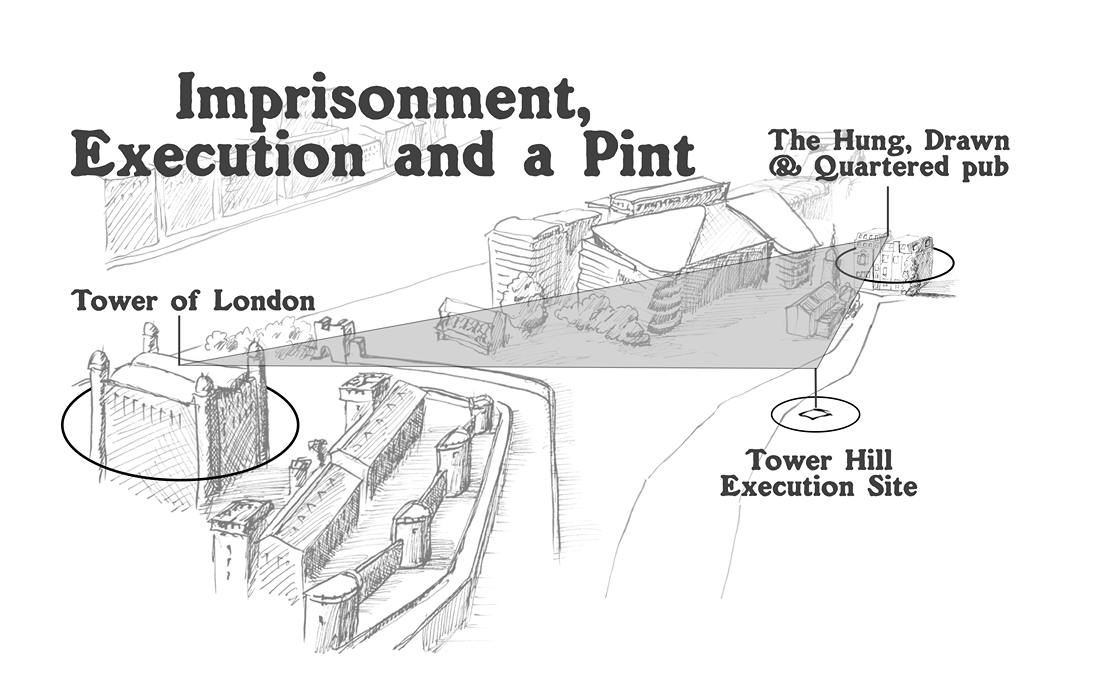
Imprisonment, Execution and a Pint
I’ve come here to see the site at which Simon Fraser, Lord Lovat, was beheaded for his role in the 1745 Jacobite uprising. No doubt he was a character and there’s lots to say about him…in my next post. When you turn your back on the monument, which is an easy-to-miss paved area 3x3m, to your left is the magnificent Tower of London (Imprisonment), under your feet is memorial (Execution), and then cheekily, over on your right is the Hung, Drawn and Quartered pub (A Pint can be had here. Note: Other drinking establishments are available, the price of a pint can go up as well as down, this is not an endorsement of this drinking establishment etc. lol.)
I get the cleverness of the pub name – I find that kind of stuff amusing – but because I’m more tuned into history these days, dead people are no longer to me just names and ‘things that happened hundreds of years ago.’ I’ve been to the Tower of London and done the various tours there and I rarely go to pubs any more. I prefer to think about the man and his life: 11th Lord Lovat, Highland chief of Clan Fraser of Lovat, nicknamed “The Fox” for his craftiness, political ambiguity and Jacobite side-switching. He was executed here, in 1747, the last person to be beheaded in Britain.
A Triangle of Interest in Wonderful London
I expect you’ll find little clusters of interest like this everywhere in London. History, buildings and roads are all knotted together like spaghetti in a pot, it’s inevitable. This is one of the reasons I say London is the greatest city on Earth. I’ve not visited all cities on the planet, but the continuous occupation of a community that’s had such an impact on the rest of the world kind of makes it inevitable that it’ll be the greatest city. I love going there for a short visit, I spent a couple of years living and working there, but I’ve made my home in Scotland.
Leave a Reply