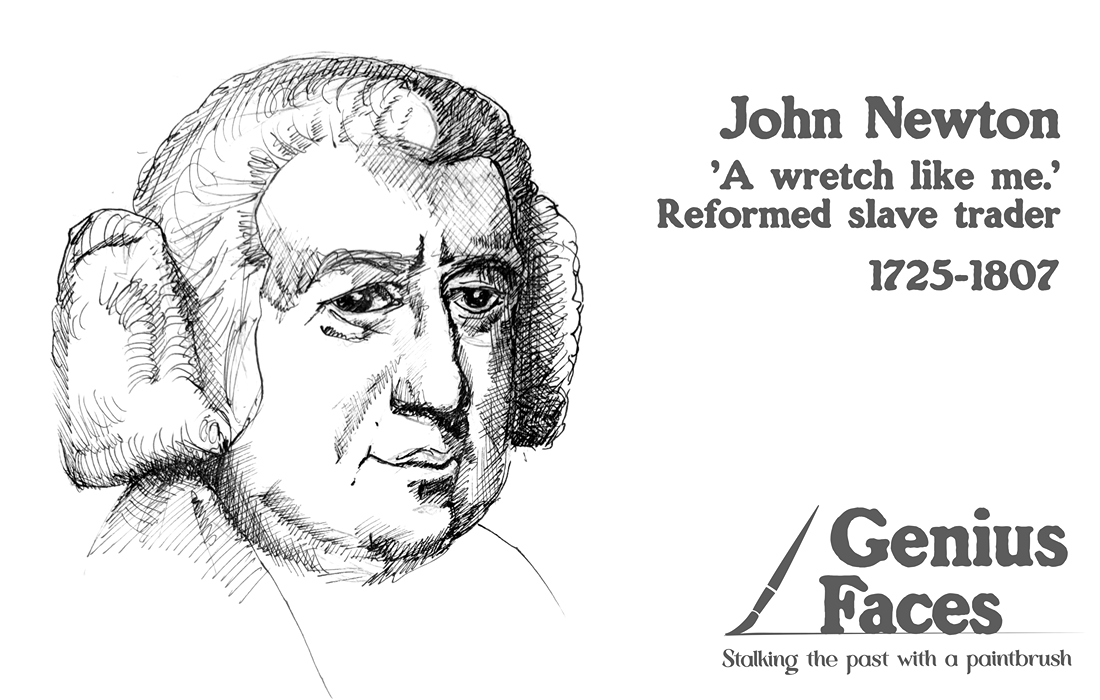
Portrait Summary
Subject: John Newton, 4 August 1725 – 21 December 1807
- John Newton was among the worst of men in the worst of professions. He started off well-intentioned, beginning his seafaring career aged 11 with his father, but by the time he reached forty years of age his CV would show he had lived the life of an Eighteenth century slave trader, slave ship captain and investor in the business. Over time he began to see the trade for what it was – the worst abuse of man’s natural rights. He became an Anglican minister and adopted the beliefs of the abolitionists.
- He wrote the hymn ‘Amazing Grace‘: Newton set to writing hymns in his parish of Olney in modern day Buckinghamshire, and this is where he wrote the lyrics to the song, ‘Amazing Grace’. He did that in 1772 to accompany a sermon, and then in 1779 he included it in a collection called the Olney Hymns, written with poet William Cowper. At this point, the hymn would be sung to most any tune or melody they wanted. It was a popular hymn during the American religious revival movement known as the Second Great Awakening, and then, also in America, in 1835, more than six decades after its original composition, it was paired with the melody for ‘New Britain’ – the melody we associate with the song today.
- The lyrics and Newton’s conversion: Newton’s opening verse is among the most famous in Christian music:
Amazing grace! How sweet the sound
That saved a wretch like me!
I once was lost, but now am found,
Was blind, but now I see.
- When you know the story of Newton’s life, the first verse is all the more poignant. When Newton wrote of being a “wretch,” he was acknowledging the seriousness of his past actions. The lines “I once was lost, but now am found” and “Was blind, but now I see” describe his spiritual awakening and growing awareness of the evil of slavery. The first verse of Amazing Grace remains a timeless reminder that transformation, repentance, and redemption are possible even after a troubled past.
- Painting: My pen and ink sketch is based on a painting by artist John Russell (1745–1806), a well-known portraitist of the time. You can see it here.

Leave a Reply