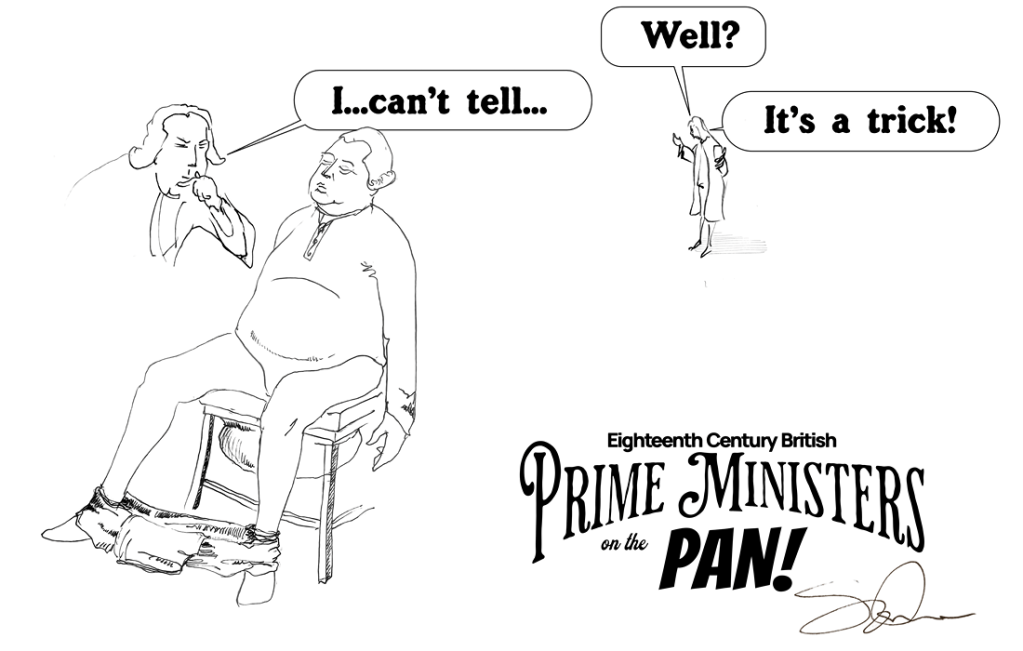
Eighteenth Century British Prime Minister No.12
Frederick North, 2nd Earl of Guilford (Lord North)
Prime Minister: 1770-1782 (12 years and 59 days)
Political faction: Tory
Predecessor: Duke of Grafton
[Life: 13 April, 1732 – 5 August, 1792]
‘PM on the Pan’ Take Aways
- Sleepy Prime Minister: Hearnshaw tells us Lord North was weak in the face of opposition, especially in relation to the King and strong personalities, adding he had a unique response when underfire: “He had the disconcerting habit of either going to sleep or appear to go to sleep.”
- Twelfth British Prime Minister: Lord North, as he’s known, became an MP at age 22 and took 3 years before he made his maiden speech in the Commons. He was admired as an orator.
- Twelve Years as PM: His time in power was long…he’s Britain’s Prime Minister with the sixth longest term in office, the third longest of all Eighteenth century PMs (after Walpole and Pitt the Younger).
- Tory: It’s kind of difficult to pin down North’s political colours. He was from a Whig background (his father was a Whig MP), but we think of him as a Tory – the second Tory PM in the Eighteenth century. He didn’t get involved in the faction politics of the Whigs, but was connected to them and the Tories, and this made him an attractive character to the King when he cam elooking for a leader to replace the Duke of Grafton.
- Endearing character: Hearnshaw says of him: “Lord North was a delightful individual…what particularly distinguished him was his genuine geniality, his tolerant friendliness, his lack of malice, and his irrepressible joviality.”
- Finances: North was never particularly well off and he received help from his father and even, it’s believed, from the King on a couple of occasions. ON the other hand, North was conscientious with the nation’s finances: he managed to reduce the national debt by £10 million by 1775. That was offset by the costs of the war with the newly-formed United States – the American War of Independence – which cost £75 million.
- He lost the American Colonies: North’s administration is mostly known as having presided over the loss of the thirteen American colonies. He led the British Government from 1770 to 1782: All the major incidents leading up to the 1776 Declaration of Independence, including the Tea Act (1773), happened ‘on his watch’.
- Oath of Allegiance: By late 1781, the war with America was all but lost when Cornwallis was defeated at Yorktown. North knew it. He tried to persuade the king to let him go, but George reminded him of his oath and ordered him to stay (so Hearnshaw tells us). Opposition to North was so great that nin March 1782, he threw in the towel and resigned.
Check out my PMs on the Pan series of posts
1. First PM Sir Robert Walpole
2. Second PM Spencer Compton, 1st Earl of Wilmington
3. Third PM Henry Pelham
4. Fourth PM Thomas Pelham-Holles, 1st Duke of Newcastle
5. Fifth PM William Cavendish, 4th Duke of Devonshire
6. Sixth PM Thomas Pelham-Holles, 1st Duke of Newcastle
7. Seventh PM John Stuart, 3rd Earl of Bute
8. Eighth PM George Grenville
9. Ninth PM Charles Watson-Wentworth, 2nd Marquess of Rockingham
10. Tenth PM William Pitt the Elder, 1st Earl of Chatham
11. Eleventh PM Augustus Henry FitzRoy, 3rd Duke of Grafton
12. Twelfth PM Lord North
13. Thirteenth PM Earl of Shelburne
14. Fourteenth PM Duke of Portland
15. Fifteenth PM William Pitt the Younger
Notes
The Prime Ministers, Iain Dale (2020) (North article by Nicky Morgan)
Lord North episode of Iain Dale’s Presidents, Prime Ministers, Monarchs and Dictators podcast
UK Govt Past Prime Ministers: Lord North
British Prime Ministers of the 18th Century, FJC Hearnshaw (1928)
 Genius Fan
Eighteenth century fans: Leave your comments here