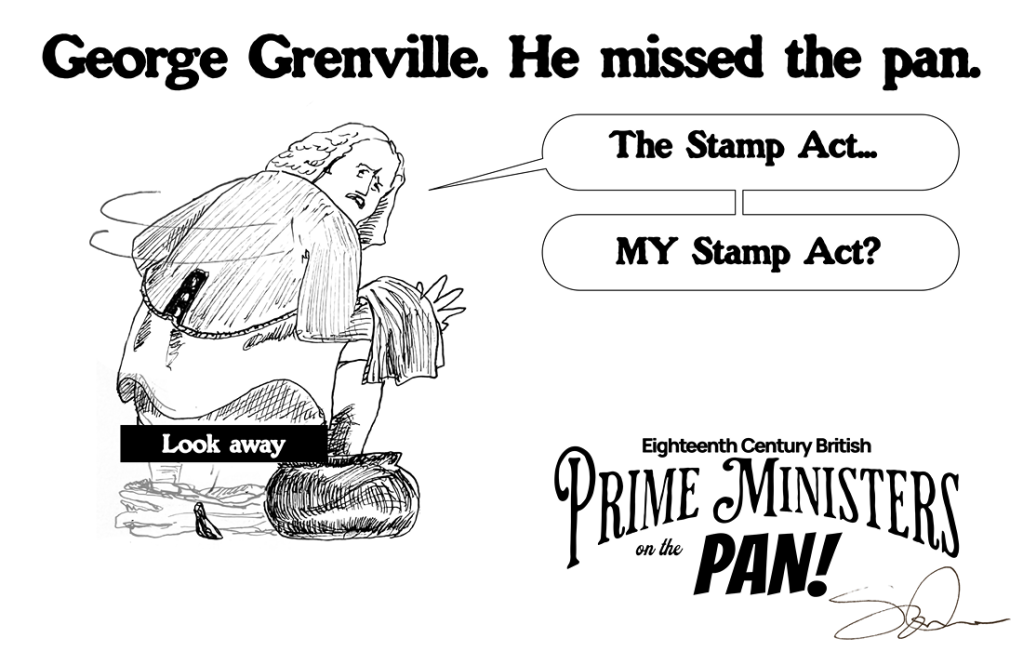
Eighteenth Century British Prime Minister No.7
George Grenville
Prime Minister: 1763-1765 (2 yrs and 86 days)
Political faction: Whig
Predecessor: Earl of Bute
[Life: 14 October, 1712 – 13 November, 1770]
‘PM on the Pan’ Take Aways
- Seventh British Prime Minister: George Grenville was Great Britain’s seventh Prime Minister, though his career was supposed to be in law.
- The Stamp Act: Remembered by many as the PM that introduced the Stamp Act (1765) to the American colonies (taxation on Americans by forcing them to use paper, stamped by the British Revenue, for newspapers, playing cards, documents etc. The purpose being to raise money to pay for the army now stationed in the colonies following the end of the Seven Years War.) This led to colonial discontent, then revolution and then…independence. The Stamp Act was swiftly repealed by Grenville’s successor, the Marquess of Rockingham.
- Political Family: Grenville was destined to go into politics. His father and maternal grandfather were both MPs, and he was one of five sons that all became MPs. William Pitt the Elder became his brother-in-law when Pitt married George’s sister Hester Grenville in 1754. And finally, George’s son William became Prime Minister in the Nineteenth century (1806-1807).
- The Cousinhood: George was part of “the Cousinhood” – a circle of Whig politicians, including the Pitts, Temples and Lyttletons, centred around the Buckinghamshire powerbroker Lord Cobham and all related by family, marriage or blood. It’s unclear how this group overlapped with ‘Cobham’s Cubs, an anti-Walpole group of Whigs which George joined upon entering parliament. The ‘cousinhood’ was separate from, but similar in attitude, to the “Bloomsbury Gang”. (I’m just chucking those names in there…you can see parliament getting very cliquey. And I haven’t even mentioned the ‘Boy Patriots’ or the Cobhamites. They’re overlapping groups of more progressive Whigs.)
- North Briton, no.45: Grenville had John Wilkes arrested and prosecuted for libelling the King in issue no.45 of The North Briton, an anti-Scottish newsletter, published in direct opposition to Tobias Smollet’s propaganda sheet, The Briton. The train of events led to Wilkes spending time in the Tower, fleeing to France and eventually becoming a hero of free speech.
- How it ended: In his essay for Iain Dale’s British Prime Minsters, Prof Stephen Conway says it wasn’t the fallout of the Stamp Act that caused Grenville to leave office. “…George III despaired of Grenville’s insecurities. Grenville had become convinced that George was still consulting Bute (his boyhood tutor) and that the King’s relationship with his former minister undermined his own authority…By July 1765, George III’s patience was exhausted.” Out goes Grenville, in comes the Marquess of Rockingham.
Check out my PMs on the Pan series of posts
1. First PM Sir Robert Walpole
2. Second PM Earl of Wilmington
3. Third PM Henry Pelham
4A. Fourth PM (1st Administration) Duke of Newcastle
5. Fifth PM Duke of Devonshire
4B. Fourth PM (2nd Administration) Duke of Newcastle
6. Sixth PM Earl of Bute
7. Seventh PM George Grenville
Notes
The Prime Ministers, Iain Dale (2020) (Grenville article by Stephen Conway)
UK Govt Past Prime Ministers: George Grenville
British Prime Ministers of the 18th Century, FJC Hearnshaw (1928)
 Genius Fan
Eighteenth century fans: Leave your comments here