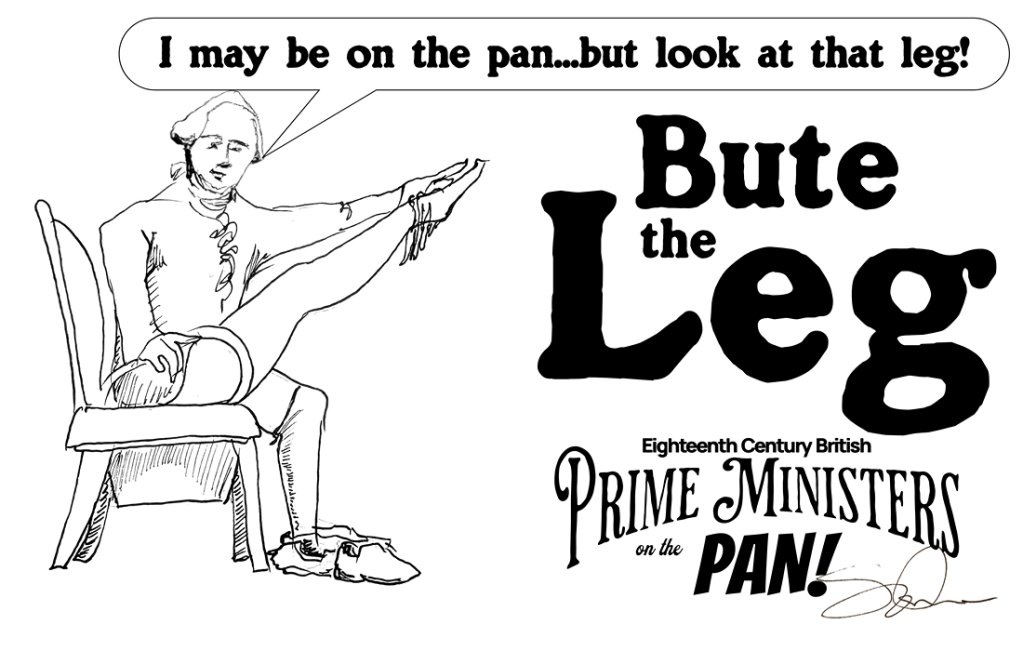
Eighteenth Century British Prime Minister No.7
John Stuart, 3rd Earl of Bute
Prime Minister: 1762-1763
Political faction: Tory
Predecessor: Duke of Newcastle
[Life: 25 May, 1713 – 10 March, 1792]
Click to read Overview of ‘PMs on the Pan‘
‘PM on the Pan’ Take Aways
- Bute’s Legs: (Yes, this deserves the top bullet point!) Bute was known to have a fine pair of legs. In the Eighteenth century an aristocratic male wore breeches and stockings which made his legs visible. Look at the famous Joshua Reynolds’ 1773 portrait of Bute. Charles Atlas, eat your heart out.
- First Scottish Prime Minister: Bute was the first Scotsman to lead the new British nation.
- First Tory: Bute’s also the first Tory to appear in the PM’s on the Pan series – as the first Tory Prime Minister.
- Disliked. No, he was hated!: He was not liked, to put it mildly. We think today our politicians have it bad, but it was pretty bl**dy awful back then. Why hated? Why because he was Scottish, of course. The memory of the 1745 Jacobite uprising (the Scots contingent marched as far south as Derby, picking up English sympathisers on the way) was still fresh in people’s minds – it was just 17 years earlier.
- He was disliked BEFORE he became PM: Bute was closely linked to the Royal Court – making him a target for animosity. That grew in intensity after the death of Frederick, Prince of Wales, in 1751, because Bute’s royal orbit, centred as it was now around the next in line – young George – was closing in on the crown.
- How it all began – Bute’s Royal connection: In 1745 the 32-year-old Bute was in Twickenham (at the time of the Jacobite rebellion) and one day made the acquaintance of King George II’s son Frederick. This led to an appointment as Frederick’s Lord of the Bedchamber, bringing him into contact with the Prince’s inner circle, his wife Princess Augusta and son George. Frederick died in 1751, but Bute stayed on in charge of young George’s household. George II died in 1760 and the prince became George III. Two years later, the young king persuaded his mentor Bute to become Prime Minister.
- Nepotism: Oh yeah. he was hated because people thought he was placing Scotsmen, friends, in positions of power. He did, but not excessively so. But then everyone did it. (Stop complaining!)
- Success: He was reasonably good at the job. He got the Treaty of Paris through (terminating the Seven Years War…with France), though he attracted even more heat when, as part of the negotiations he give up two Caribbean islands and only got massive Canada in return. (For crying out loud!)
- Resignation: Bute surprised everyone when he resigned from office after just 318 days in office. The young king encouraged him to take up the post originally, but he never really enjoyed it. He was wealthy and no longer needed to work.
Check out my On the Pan series of posts
1. First PM Sir Robert Walpole
2. Second PM Earl of Wilmington
3. Third PM Henry Pelham
4. Fourth PM Duke of Newcastle
5. Fifth PM Duke of Devonshire
6. Sixth PM Duke of Newcastle
7. Seventh PM Earl of Bute
Notes
The Prime Ministers, Iain Dale (2020) (Bute article by David Torrance)
UK History of Government, Bute
British Prime Ministers of the 18th Century, FJC Hearnshaw (1928)
 Genius Fan
Eighteenth century fans: Leave your comments here