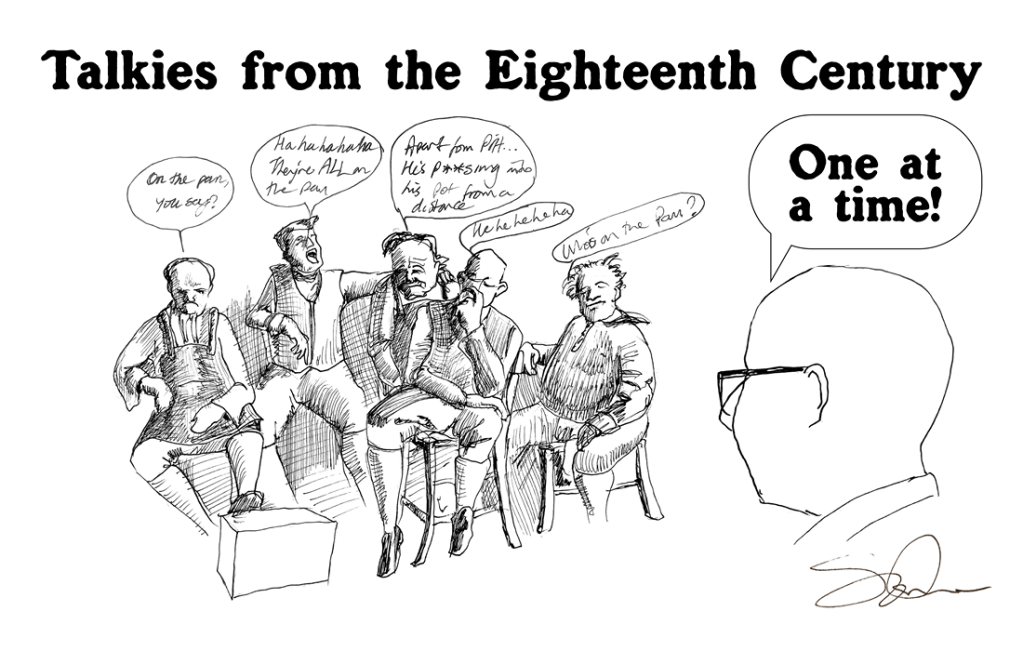
In modern cartoons we’re used to seeing clear text in a uniform speech bubble, but it’s not always been like that. Our Eighteenth century forebears who created satirical prints based around political, social and cultural issues, gave us the early speech bubble. I noticed that artist Thomas Rowlandson (1757-1827) did NOT use any speech bubbles in his Picturesque Beauties of Boswell (mentioned in a previous post), yet he used them a lot, especially towards the end of the Eighteenth century, when his career got going.
As well as Rowlandson, the master of the speech balloon was James Gillray (1756-1815), known as the father of the political cartoon, but plenty of others gave them a go, including the great William Hogarth (1697-1764). But the format of the bubble wasn’t formalised. In the sketch for this post I’ve shown five colleagues taking a break from their work in a shipwright’s office, reflecting on the Genius Fan ‘PM’s on the Pan’ series. Their chat is contained in a balloon. I say call them bubble, but these devices are also known as banderole.
Characteristics of Eighteenth century speech balloons
- The text, the person’s speech, was cursive (handwritten), making it hard to read.
- The text was often NOT on a flat line, but could be on an uneven or curved line
- The text was often NOT on a horizontal line, but could be sloped from bottom left to top right or top left to bottom right. It could even run vertically from top to bottom or bottom to top.
- There was often little or no attention paid to the convention of all text justified to the left hand side.
- The balloon content could often include more than 35 words, making reading of so much cursive text difficult.
- There were no rigid template for the enclosing balloon, ie. no parallel top and bottom lines with identical curves at either side. This means the balloons can appear scruffy to modern viewers.
- Sometimes the balloon was more of a long ribbon, rather than a balloon or bubble.
- Sometimes the balloon would have an opaque white background so the text could stand out, and other times the balloon was simply a bubble with an edge and no background to it (so the text would appear to be superimposed over what ever the background happened to be).
- There were no standard margins between the text and the edge of the speech balloon. Modern speech bubbles have a clean margin of white space running fully around separating the text from the bubble edge.
- Also the text often was not evenly spaced within its balloon, so it could sit near the top of the balloon, while there was a large margin below it/
- There does seem to be an appreciation for the order of balloon reading, most of the cartoons I’ve read work when you read from left to right.
- The artists sometimes use the height of the speech balloon to indicate this should be read before balloons that are lower in height.
- The balloons were not always a straight line, but could be a broken line or a line with a curl in it.
- There doesn’t appear to be any indication of emotion in the shape of the balloon or the tail (that’s the part that points to the speaker). Modern artists use floating bubbles in place of a tail to convey thought, or a lightning bolt-shaped tail to create drama. I can’t see any of that type of thing.
 Genius Fan
Eighteenth century fans: Leave your comments here