This morning I rediscovered a treasure I bought back in 2023: A 1973 collection of the Picturesque Beauties of Boswell. It’s a squarish pack of twenty prints, copies of etchings made by Eighteenth century artist, illustrator and portraitist Thomas Rowlandson. If you’re a Boswell fan…indeed, a Boswellian, then you will recognise these pictures. The one of Boswell and Johnson walking arm in arm up Edinburgh High Street is one of the most famous images from Boswell’s life, and the text accompanying the image carries the immortal line from Johnson, whispered into Boswell’s ear: “I smell you in the dark.” (See the full list of illustrations at the end of this post.)
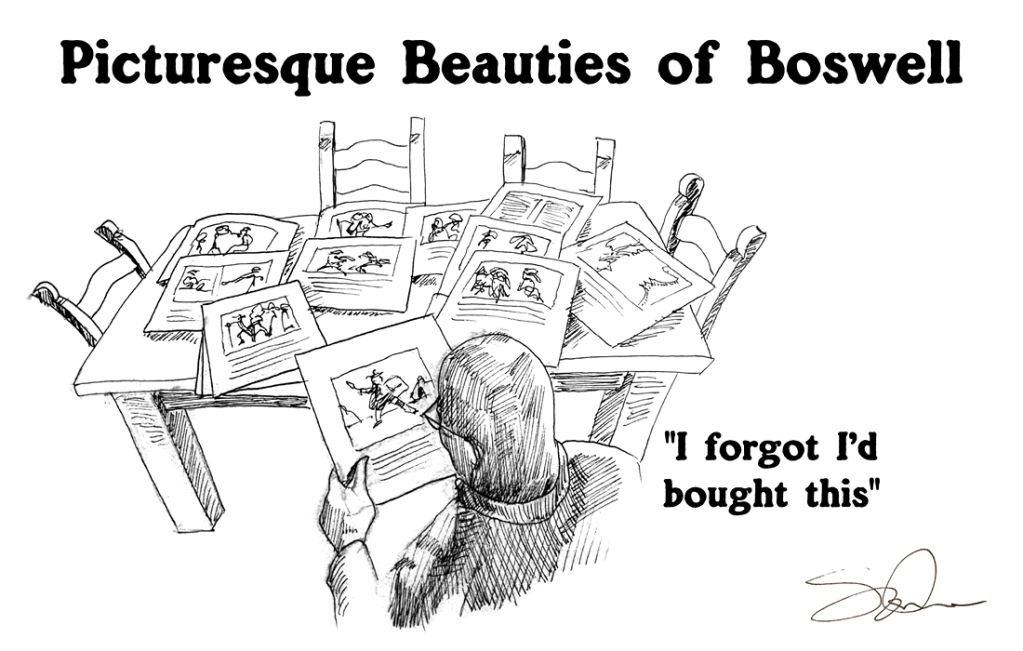
I forgot I had this collection and only discovered the pack of prints when I went digging into my chest of drawers looking for a single sock to make a pair and there, laying flat on the bottom, hidden by underpants I haven’t worn in a loooong time, was this bi-centenary treasure. I bought it on AbeBooks during my “1773 Boswell and Johnson Tour of Scotland” phase (cost me £35, as I recall) and had always planned to mount and display some of them round the house, but just never got round to it. And this evening, I spread them out on the dining room table to enjoy Rowlandson’s mastery of caricature.
About the Collection
The collection was prepared by the National Library of Scotland in 1973 – two hundred years after the original journey by Boswell and Johnson (in 1773, for those of you who are arithmetically challenged). I bought the set in 2023, fifty years after they were published and two hundred and fifty years after the original tour. They were created from etchings by Thomas Rowlandson (1756-1827), who it’s believed used rough sketches by his collaborator Samuel Collings (dates of birth and death are unknown). His prints were published in two sets by two printsellers, E Jackson in Marylebone Street, and G Kearsley in Fleet Street, London. The first ten prints were published on 9 June 1786 and the second set on 1 July 1786.
Timings of Rowlandson’s Prints
Although the tour of Scotland was undertaken between August and November 1773, the first account of the adventure for the public to read was published by Samuel Johnson early in 1775. But that was a dry, almost ethnographic account of what Johnson witnessed. It was successful, but nowhere near as interesting as Boswell’s account. Boswell knew he would publish an account, but only after Johnson’s death. (Boswell felt Johnson made it clear he should not publish until after he was gone.) So it was that Johnson died in 1784 and Boswell sprang into action and had his account of the journey published to great acclaim in 1785, ten years after Johnson’s account and 12 years after the tour itself. Boswell’s account is a great romp, with lots of fun and gossipy scenes that’s fun to read even today in the Twenty first century. So it was an obvious target for caricaturists who were flourishing at the time. Rowlandson’s prints were published just a year after Boswell’s book, at which time it was a bestseller.
What’s in the Collection?
Folded insert
This insert is the same paper and dimensions as the prints, but is folded vertically and slips snugly into the plastic envelope. It contains an excellent and informative introduction, written by Ann Matheson (see below), describing the tour, the images, a biographical account of Rowlandson and some detail about the publication. There is a short note attributed to the Librarian, thus:
“The following facsimile of Rowlandson’s satirical interpretation of some incidents in the Highland excursion of Boswell and Johnson has been produced to celebrate its bi-centenary.
I have particularly to thank three of the Library’s staff – Mr J H Loudon, Keeper of the Antiquarian Division*, who devised the publication, Miss Ann Matheson, of the Antiquarian Division, who wrote the introduction, and Mr MA Begg, Publications Officer, who collaborated with the Stationery Office in the production.”
My collection comes in a square(-ish), clear plastic envelope. As well as the folded insert there are 22 loose, thick paper sheets in a yellow-cream colour and ‘front and back’ card boards, caramel coloured. These sheets measure 410 x 370mm.
The Front Cover
The cover has a large reproduction of the outline of Scotland and the route taken by Boswell and Johnson, and the lines above it: “Picturesque Beauties of Scotland, by Rowlandson”. The name “National Library of Scotland” is at the top left and at the top right it reads “Edinburgh 1973”. At the bottom right it reads: “Map of the Tour through Scotland and the Hebrides, by Samuel Johnson LLD and James Boswell Esq, in 1773.” There is nothing printed on the rear of this.
The Back Cover
On the back cover there is a circle in the middle with the printed text: “Price £1.50 net” and “SBN 902220 11 X”. At the very bottom is the text: “Crown copyright 1973”, then below that: “Printed in Scotland for Her Majesty’s Stationery Office by Alna Press Ltd. Broxburn”. And below that: “Dd 250683/3232 53-2068 K16 8/73”
The first two sheets are ‘extras’
The first sheet is a reproduction of the map of Scotland showing the route taken by Boswell and Johnson – the same as the image on the front card (above). The second sheet is a facsimile of the original pages accompanying the prints back in 1786, listing the prints in the same order as set out in this 1973 edition – see below.
First set of prints
- Frontispiece
- The Journalist
- The Embrace
- Walking Up the High Street (This is the famous illustration of Boswell and Johnson walking up the High Street in Edinburgh)
- Tea
- Chatting
- Veronica. A Breakfast Conversation
- Wit and Wisdom
- Setting Out from Edinburgh
- Scottifying the Palate
Second set of prints
- Revising for the Second Edition
- The Procession
- The Vision
- Lodging at M’Queen’s
- The Reconciliation
- The Dance on Dun-Can
- The Recovery
- Sailing Among the Hebrides
- The Contest at Auchinleck
- Imitations at Drury-Lane Theatre
* ”Keeper of the Antiquarian Division” has to be about the best job title ever. It’s like Indiana Jones!
 Genius Fan
Eighteenth century fans: Leave your comments here