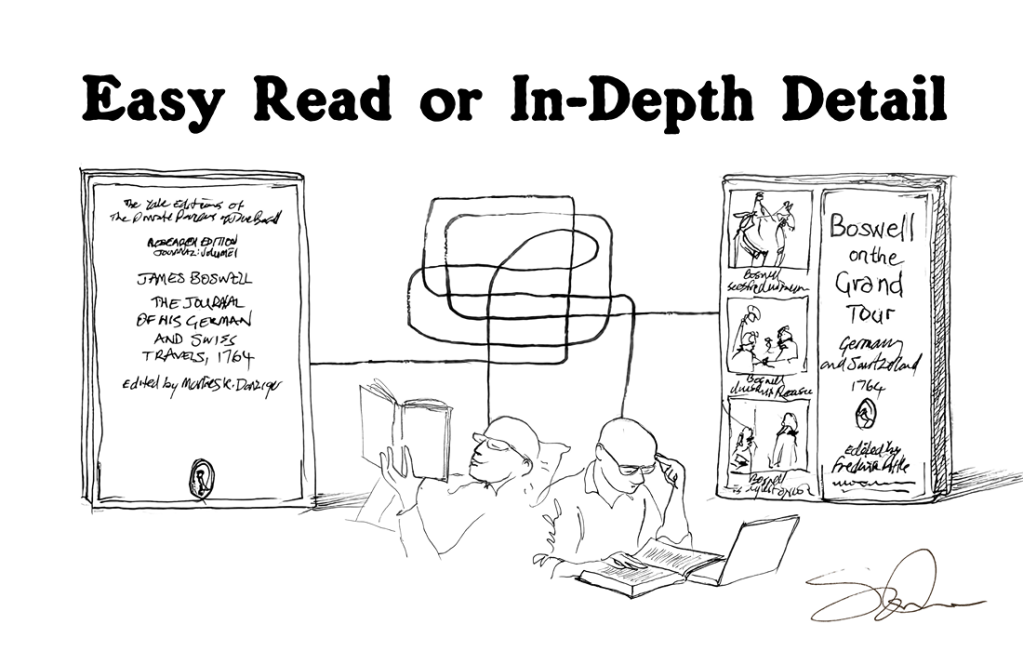
This post is about the differences between the Trade and Research editions of James Boswell’s journals published by Yale University. To the ordinary reader this may sound deathly boring, but I’m a Boswell freak and I would have eaten up any post about the minutiae of scholarship when I first discovered Boswell and his world. I know there are plenty of people like that out there, so this post is for you. You know who you are.
This post looks at the appearance, cost and structure of the two editions. In a second post I’ll look at the content.
Two Differently-Edited Versions of the Same Boswell Journal
Boswell’s archive
Scottish writer and lawyer James Boswell (1740-1795) created his own archive of personal letters, memoranda, drafts of books and of course the journals he kept throughout his life. These papers were ‘lost’ after his death and then rediscovered, recovered, negotiated over, sold, bought, lawyered over and privately published until finally the whole lot (mostly) was bought by Yale University in the USA. Read more about the Boswell papers.
Plans for publishing such a gigantic archive
Prof Frederick Pottle, who became head of the Yale Editions of the Private Papers of James Boswell tells us in his detailed book, Pride and Negligence, that the idea to create two parallel editions was around even as far back as 1929. By 1949 it was decided, “The Yale Editions of the Private Papers of James Boswell…should consist of a research edition for scholars and a trade or reading edition of a part of the same material for the general public.” The research edition would be structured in this way:
- Boswell’s Journals
- Boswell’s Correspondence
- Boswell’s Life of Johnson – a critical text
The reason for this post is that I just recently bought a copy of the Research edition of the first part of Boswell’s Grand Tour of Europe. I thought it would be interesting to compare my recently-bought Research edition with my Trade (or reading) edition, bought and read back in summer 2021.
My recommendation on which edition to buy
It’s simple, if you want a good read and want to learn about the amazing and frequently ‘awkward’ experiences of an Eighteenth century twenty something charging around Europe trying to make the acquaintance of anyone famous, then go for the Trade edition. Also, if you’re new to Boswell, that’s your book. If you know Boswell and you want to go deeper and develop your own informed opinions about Boswell or if you’re interested in scholarship, or editing and manuscripts, then the Research edition is probably more your bag (but you gotta pay for this edition).
Trade
Boswell and the Grand Tour: Germany and Switzerland 1764
Edited by Frederick A Pottle, Sterling Professor of English at Yale University. Copyright, 1928, 1953. McGraw-Hill Book Company, Inc. This book is the 4th in the 14-volume Trade edition edition. The series is commonly known as ‘Boswell’s Journals’ and includes the most famous of all, Boswell’s London Journal 1762-1763.
Research
James Boswell. The Journal of his German and Swiss Travels, 1764
Research Edition, Journal: Volume 1, Edited by Marlies K Danziger. Yale University 2008. Edinburgh University Press 2008. Yale University Press. This Research Edition is the nearest a reader will get to actually handling the original documents, the pages on which Boswell wrote his accounts. But it’s always
Cost: Trade Versus Research Editions
Trade
You have to buy the Trade edition second hand now – it was published in 1953 – and is no longer in print. But the good news is you can pick up good second hand copies for less than £10. I bought my copy from Ebay for £5.49. That’s a good price, the book is in great condition, it came with a great quality dustcover, and it’s the American McGraw-Hill version (rather than the British William Heinemann version).
Research
Research editions in this series can cost a lot of dosh. I got mine on Ebay for £47.55, postage free. I’ve seen other second hand versions for £80+ so I’m pretty pleased. A new version can cost £100 or more. Look at the cost of any Research edition – new – and you’ll see they’re expensive for the general reader. I’ve got four Research volumes and I only bought them second hand, because they were about £20 or less. Spending nearly £50 on this volume was highly unusual for me.
Difference in Size and Appearance
Trade
* Dimensions: 165 x 241 x 35mm (without dustcover), 955g
My Trade edition dates from 1953 and is the American version, McGraw-Hill. On the front of the dustcover, designed by American Warren Chappell (1904-1991), are the three major scenes from the travel account which took Boswell through Germany and into Switzerland: 1. Boswell seeing Frederick the Great, 2. Boswell dining with Jean Jacques Rousseau and 3. Boswell as a guest of Voltaire. To the right of these three illustrations is a tall black panel, with the book title, the Boswell coat of arms and crest and then the name and title of the editor, FA Pottle. The spine has very nearly the same text information, but also a nice illustration of Boswell standing with his nose up, aloof, hand in pocket and holding up his hat as if approving something he’s observing. The reverse of the cover has blurbs for the previous three volumes: 1. Boswell’s London Journal, 1762-1763, 2. Boswell in Holland, 1763-1764, 3. Portraits, by Sir Joshua Reynolds. And finally the front and rear flaps is a description for the general reader of the story told within its pages. Behind the dustcover, the boards are the familiar blue with the spine in dark blue, with gold lettering (no Boswell illustration).
Research
* Dimensions: 162 x 239 x 30mm (without dustcover), 878g
In contrast to the attractive cover design of the Trade edition, the dustcover of the Research edition is text only. It follows the design of all Research editions in this series and tells you it’s a serious book, not entertainment. The cover is gloss in a beige/yellow colours with separate text in brown and slate grey. There are no illustrations in this cover. At the top of the cover in italic slate grey, it says The Yale Editions of the Private Papers of James Boswell. Below that is the title, the editor’s name and at the bottom is the Boswell family crest. On the spine is text with the book title and editor name. At the bottom of the spine it reads ‘Edinburgh Yale’. On the back of the cover is a description of this volume and how it fits into the Yale research output: 1. Journals, 2. Correspondence, and 3. A research edition of The Life. Below that are two bar codes, one for Edinburgh University Press and the other for Yale University Press. Inside the flaps, on front and rear is a more research-focused account of the contents of this volume, and a list of some of the research editions also available. Remove the dustcover on this volume and it’s plain black with text (title, editor and publisher) in gold lettering.
Pages, Paper and Quality of Trade and Research Editions
The Trade volume has 357 pages, all of which have deckle edges and blackened tops. The paper is thicker, more textured and perhaps more yellowed through age. The Research edition has 436 pages, yet it’s thinner than the Trade volume. It’s clearly much more of a textbook, with pages in lighter cream colour and accurately trimmed. It has a paper quality declaration on one of early unnumbered pages: “The paper meets the requirements of ANSI/NISO Z39.48-1992 (Permanence of Paper).” There’s also a line telling the reader the text is set in Goudy typeface.
Content of the Trade and Research Editions
Editorial and Advisory Committee Lists
Both volumes have separate lists. See the table below for the number of names listed under each committee.
| Trade Edition | Research Edition | |
| Editorial Cttee | 5 people | 11 people |
| Advisory Cttee | 24 people | 19 people |
| Illustrations | 10 | None |
| Maps | 2* | 4* |
| Introduction (pages) | 14.5 | 24.5 |
| Index (pages) | 27 | 43 |
Table of Contents
The table of contents for the Trade edition is shorter than the Research edition.
Trade
* Introduction: ix
* Text of Journal of a tour through the courts of Germany: 1
* Text of Boswell with Rousseau and Voltaire: 195
* Appendix I: Successive drafts of Boswell’s first letter to Rousseau: 323
* Appendix II: Letter of Rousseau to Alexandre Deleyre: 327
* Index: 331
Research
* Acknowledgements: xv
* Editorial Procedures: xvii
* A Note on Distances and Currency: xx
* Cue Titles and Abbreviations: xxi
* Introduction: xxix
* The Journal: 1
* Appendix 1: Foreign Tour Papers and other Writings: 337
* Appendix 2: Rousseau: 350
* Appendix 3: Expense Accounts: 370
* Maps: 389
* Index: 394
* Maps
The Trade edition is a more accessible book – it has a map on the inside at the front – the spread across the front board and onto the facing page (Boswell’s route from Utrecht to Bale in the north of Switzerland) and on the inside of the back board only a much more detailed map (Boswell’s route in Switzerland from Bale to Ferney). Both maps include the following: “Redrawn by Harold K Faye from a map by Robert de Vaugondy in his Atlas Universel, 1757.” There are four maps in the Research edition, but as you’d expect in a research book, they’re stashed away in the Appendices.
Notes
Boswell and the Grand Tour: Germany and Switzerland 1764, Ed. Frederick A Pottle (1953)
James Boswell. The Journal of his German and Swiss Travels, 1764, Ed Marlies K Danziger (2008)
Pride and Negligence: The History of the Boswell Papers, Frederick A Pottle (1982)
 Genius Fan
Eighteenth century fans: Leave your comments here