After making an Edinburgh site visit for a work event, my guide happened to mention the premises – the Royal College of Physicians – was the oldest building in Queen Street. Followers of Genius Fan are likely to know that’s a pretty big deal for Enlightenment history, placing it in the early 1770s. A couple of questions later I was in a first floor drawing room of this extraordinary building designed by Scots architect Robert Adam. My guide, who I’d only asked to show me the Great Hall conference facilities, was unaware of my Eighteenth century obsession, but that all changed when I dropped the business chat and switched focus for this unexpected mini-tour.
Among the portraits on the walls were notables of the Scottish medical world – one easily recognised as William Cullen (1710-1790). His name and portrait popped up often back in October 2025, while I was learning about the Scottish medical scene of the Eighteenth century, and visiting Lanark to view and sketch the book collection of William Smellie (1697-1763), father of modern obstetrics. Cullen from Hamilton and Smellie from Lanark were contemporaries.
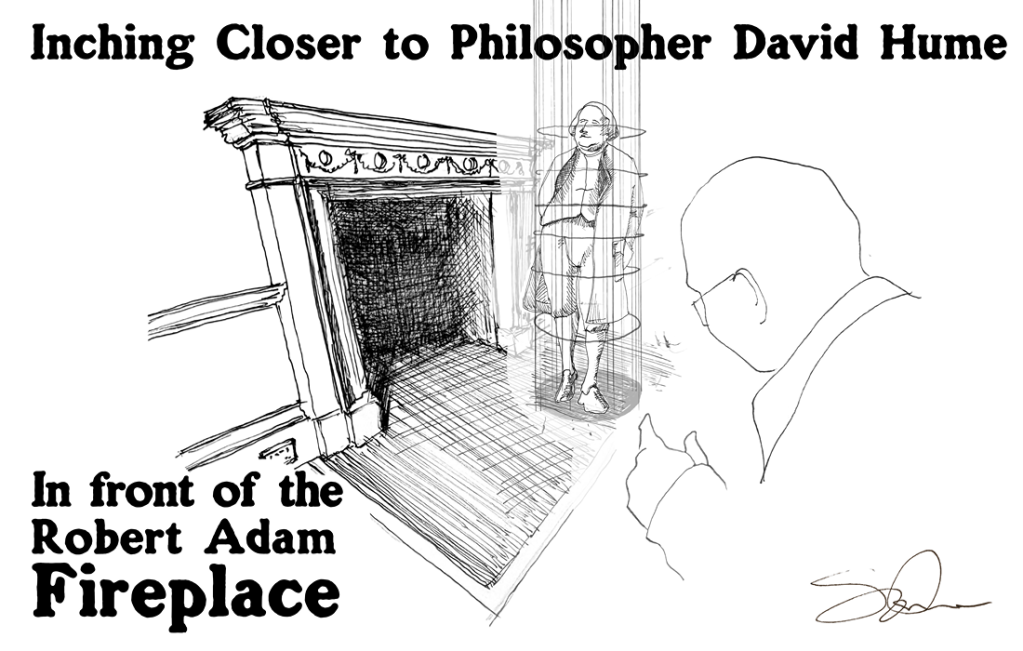
Then my guide says: “And this is the original Robert Adam fireplace.” I was already dizzy with just being there and seeing the Cullen portrait. Now she tells me about the fireplace! I’m ready for collapsing. I get a few snaps and realise I might be taking up too much time and have to catch a tram…all that stuff, so say I better head off. As we’re leaving the room I learn it’s the original ceiling, too. Ahem. When will this afternoon’s surprises and Eighteenth century ‘gifts’ end? On the way out I darted into the RCP museum to see the current exhibition, Rag: The History of Blood. Among the Eighteenth century items, in a tall case by the wall, was William Cullen’s mortar and pestle, dating from the 1730s. Both items dwarf the little mortar and pestle we have at home (and never use), weighing in at 16kg!
And of course, when I step out into Queen Street, that’s a major highway in the design of Edinburgh’s New Town, architected by James Craig and on which work began in 1769. So Eighteenth century-a-go-go for me that afternoon. Late that evening, after my wife went to bed, I sat on the sofa with the two dogs and read through the promo leaflets I lifted from the Royal College earlier. It says this: “During his residency Ord [Robert Ord, Chief Baron of the Scottish Court of the Exchequer] entertained many notable members of Edinburgh society in these rooms, including the philosopher and essayist David Hume.” I’m floored!
Hume’s one of my heroes and yet I didn’t even stop to think that he may have walked this same floor, warmed his buttocks at the fire in the Robert Adam fireplace and looked out these same windows, north across the Firth of Forth. I hadn’t tuned myself into that possibility while I was in that room. But to be honest, anyone who strolls round the New Town is treading in the footsteps of many of the famous names from that period including my other hero Adam Smith, and my top hero (so many heroes) James Boswell.
Note to self: Pay attention when you’re strolling round Edinburgh. It’s thick with history and memories.
 Genius Fan
Eighteenth century fans: Leave your comments here