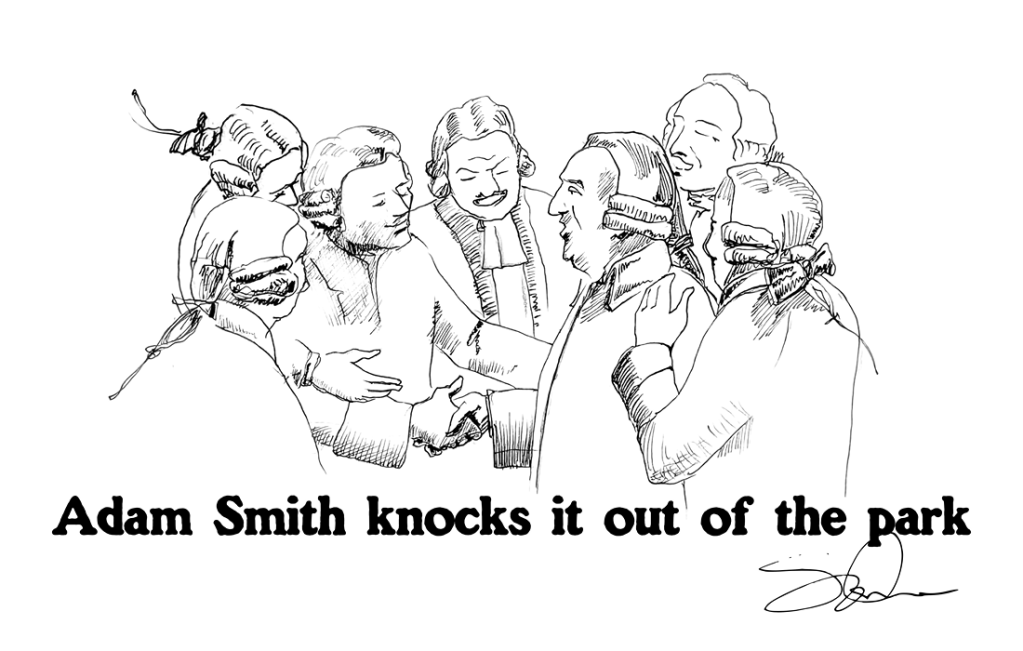
On 9 March 2026 a bunch of folk will celebrate the 250th anniversary of the publication of the Wealth of Nations. The book, written by Scottish philosopher Adam Smith, was published in 1776. Most people haven’t heard of the book and so will go about their business unaware of the significance of this date and the book that led to its author being labelled the father of modern economics.
Not interested? Don’t leave! Stay for a couple more seconds…Let me try to summarise: Think of the Wealth of Nations as an Eighteenth century textbook on economics in which Smith describes how countries prosper when people are allowed to trade freely and without government interference.
Hang on! Gimme another go: If you like history (if you’ve come to Genius Fan then you LOVE the Eighteenth century – that’s history) then let me tell you this book is an artifact that lives on through time. Lots of other historical artifacts have just faded away, but this book keeps giving. Smith’s accomplishment has never been more astonishing.
Wait, wait, wait, wait!!! One final go – a change of tack: The author Adam Smith (1723-1790), was kidnapped by gypsies as a child, was so absent-minded he once put bread and butter in his teapot and also once walked 15 miles in his PJs while daydreaming, his best friend in adulthood was the ‘Great Infidel’, Scottish philosopher David Hume, and at the age of 53 he wrote the Wealth of Nations making him one of the most influential men of all time.
So, now you want to know more, right?
The Wealth of Nations
Firstly, the full title of this book is typically Eighteenth century…long and descriptive: An Inquiry into the Nature and Causes of the Wealth of Nations. I have the Everyman’s Library edition of the book. It’s big (fat) and intimidating, though, of course, like all Everyman’s Library editions, it’s beautifully bound). It runs to 622 pages, densely typographed with a slightly muddy typeface (it dates from 1910 and mine is the 1991 edition), and at 43 lines of 11 words on average, that’s…Let me work that out (gets a piece of paper…and a pencil…) – I make it 294,206 words. I’m probably never going to read this book (ahem, I know 100% that I will never read it).
It may be a tough read, but the ideas in it have been expertly simplified and described by Smith. He was used to communicating difficult concepts and ideas to students attending his classes in ethics and law, early on in his career at the University of Glasgow. According to David Daiches Raphael, who wrote the Introduction to my Everyman’s Library edition, “Most of the youngsters who attended Smith’s classes in their second year of university study were twelve to fourteen years old… The Wealth of Nations is far more sophisticated than the lectures from which it grew, but Smith retained the aim and the knack of making himself understood by the non-specialist.”
Eamonn Butler’s Condensed Wealth of Nations
There’s a version of the Smith’s book which you might give a try if you’re like me: you know you should read the book, but don’t have time or staying power. Take a look at Eamonn Butler’s Condensed Wealth of Nations. There’s a free download link on the website of the Adam Smith Institute, for which Butler is co-founder and director. It’s a much more manageable 70 pages of much less dense copy, and nicely simplified.
Butler opens with this sentence:
“A nation’s wealth is its per capita national product – the amount that the average person actually produces.”
Compare that to Smith’s opening sentence:
” The annual labour of every nation is the fund which originally supplies it with all the necessaries and conveniences of life which it annually consumes, and which consist always either in the immediate produce of that labour, or in what is purchased with that produce from other nations.”
Go for Butler’s Condensed Wealth of Nations.
Wealth of Nations: Free from The Online Library of Liberty
I know I’m always harping on about getting the book and turning the page, but the Wealth of Nations is long ago out of copyright and, as you’d expect, there are versions online. The Online Library of Liberty (OLL) is one such example. Of course, an advantage of the online version is it’s searchable – great if you’re doing research.
Three ideas (among thousands) from the Wealth of Nations
So many people will do this way better than me. But here are three things I think you should know, which pop up all the time in discussions of this book.
Before the Industrial revolution. Smith wrote his book in the 1760s and 1770s, the very dawn of the industrial revolution and his observations and reading reflect that. The country population was already starting to migrate to towns and cities in search of work, but the era of dark satanic mills, railways and industrial coal mining had yet to get under way. This was the proto-industrial revolution.
The ‘pin making’ factory. Smith explains how specialisation of tasks in manufacturing can massively increase output. This is obvious to us today, but not so much back in 1776. See how he’s got wealth, production and labour in his sights from the start. He famously uses the example of the pin making process in which one man might make a single pin, from start to finish, in one day. But divide up all the tasks among ten men, working in a conveyor belt fashion – each man does a single task over and over again for a full day – then the output would be 48,000 pins. This example launches Smith’s book and gives an idea of how he’ll lead the reader through his proposition.
(Book I, Chapter I – p.5 in my Everyman’s Library edition.)
The ‘Invisible hand’. This is one of those expressions that’s forever linked with Smith, yet the precise term ‘invisible hand’ only appears once in the book. It goes like this: In striving to make the best of their lot – that is people earning wages and improving the life of their family – a population will drive up the revenue of society. He writes, “By pursuing his own interest he frequently promotes that of the society more effectually than when he really intends to promote it.” He’s talking about a person’s ‘self-interest’ and the knock on effect of this is that the associated supply and demand will regulate the economy.
(Book IV, Chapter II – p.400 in my Everyman’s Library edition).
 Genius Fan
Eighteenth century fans: Leave your comments here