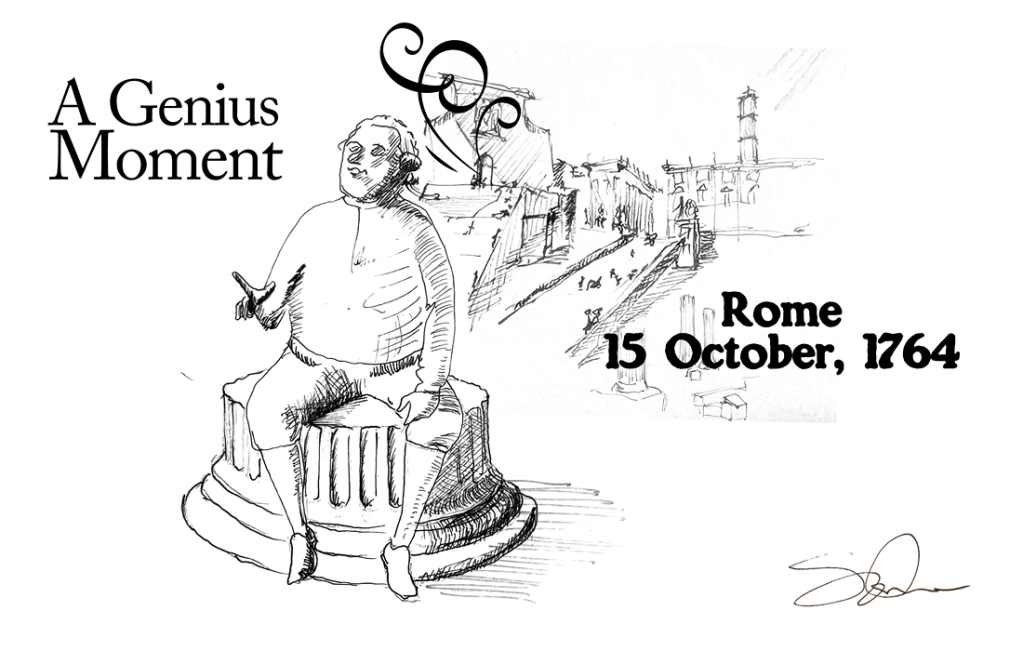
It occurs to me that all great things have a moment of conception, a single point in time when the clouds part, the curtains open, the light comes on…and an idea is born. I call this a Genius Moment. Edward Gibbon had one and it led to his great work, The History of the Decline and Fall of the Roman Empire. Last Tuesday (17 February 2026) was the 250th anniversary of the publication of the first volume of that work, and in this post I’m going to describe that Genius Moment.
Gibbon’s Genius Moment on his Grand Tour
In Rome, on 15 October, 1764, Edward Gibbon sat down to gaze at the ancient ruins around him. This was the Eternal City, his goal for years since discovering a love of the stories of the ancient world. He was making his Grand Tour, a sort of Eighteenth century gap year made by most ‘young men of means’. It was an opportunity to sow one’s wild oats, but that was most likely not on Gibbon’s mind. He was there to see the places of antiquity that filled his imagination.
Gibbon, 27, may have been English, but he was no stranger to travel. He had lived and studied for five years in Lausanne, Switzerland; he’d returned to England and taken up a post in the Hampshire Militia, from 1760 to 1762 – a national domestic response to the Seven Years War; he travelled to Paris and back to Lausanne, before finally making the trip of his lifetime from April 1764 to April 1765. And it was during this year in Italy that his Genius Moment struck.
Gibbon’s Romantic Tale
The story is very romantic: Gibbon sat down in the late afternoon after meandering through the ruins of Rome, and while listening to the monks singing vespers the idea came to him to write the book that would result in him being immortalised. (People thought like that, then.) That’s the commonly told story, but there are a number of different versions.
Gibbon’s Genius Moment in his Decline and Fall
The last sentence of the sixth and final volume in his epic History of the Decline and Fall of the Roman Empire (Everyman Library edition) tells us this:
“It was among the ruins of the Capitol that I first conceived the idea of a work which has amused and exercised near twenty years of my life, and which, however inadequate to my own wishes, I finally deliver to the curiosity and candour of the public.” Lausanne, June 27, 1787
Gibbon’s Genius Moment in his Memoirs
Then, in his autobiography, written in a number of incomplete versions before he died in 1794, Gibbon described the event again. There are a number of versions of this, I have the Penguin Classics 1990 edition called Memoirs of My Life. In Chapter 6: Grand Tour – Buriton-London – Father’s Death (1763-1770), he writes:
“In my Journal the place and moment of conception are recorded; the fifteenth of October 1764, in the close of evening, as I sat musing in the Church of Zoccolanti or Franciscan friars, while they were singing vespers in the Temple of Jupiter on the ruins of the Capitol.”
This is better, more detail and far more romantic!
Genius ‘Moment’…on Hiatus
Gibbon immediately continues: “But my original plan was circumscribed to the decay of the City, rather than of the Empire; and, though my reading and reflections began to point towards the object, some years elapsed and several avocations intervened before I was seriously engaged in the execution of that laborious work.”
It seems he didn’t have a flash in the pan moment of inspiration for a book about the Empire, but just about the decline and fall of the city of Rome. Many of us have experienced that ‘project creep’, when an achievable goal gets added to and tweaked and expanded until it’s ten times the size of the original concept. Well, that was Gibbon, but he was well capable of managing an expansion of this scale in the scope of his project.
Genius Moment…Sheffield Edition of Gibbon’s Memoirs
I said earlier on that Gibbon wrote a number of incomplete versions of his memoirs. The original version was compiled by Gibbon’s close friend John Lord Sheffield and published in 1827 as Memoirs of My Life and Writings (different from my 1990 Penguin Classics edition, Memoirs of My Life).
You can find a copy of that original work by Lord Sheffield at the free Gutenberg.org online library. There you’ll find the following passage about Gibbon’s Genius Moment with the exciting additional description that the friars were ‘bare-footed’. (This is gold!)
“It was at Rome, on the 15th of October 1764, as I sat musing amidst the ruins of the Capitol, while the bare-footed fryars were singing vespers in the temple of Jupiter, that the idea of writing the decline and fall of the city first started to my mind. But my original plan was circumscribed to the decay of the city rather than of the empire: and though my reading and reflections began to point towards that object, some years elapsed, and several avocations intervened, before I was seriously engaged in the execution of that laborious work.”
Genius Moment – one of Gibbon’s rare fictions
Throughout his six volume work Gibbon shows himself to be a scholar to be trusted, not least because he cites his sources, something not commonly done at that point. But this Genius Moment may be just what Gibbon wants us to believe rather than what actually happened. For example, the Temple of Jupiter in which Gibbon says he heard bare-footed fryars singing, was not longer in existence; it was long ago demolished and replaced by the church, the Basilica of Santa Maria in Aracoeli.
The US scholar Leo Damrosch, in his Great Courses lecture series Books That Matter: The History of the Decline and Fall of the Roman Empire, says Gibbon’s account may have been what he thought should have happened, especially since there’s no mention of this event on the Capitoline Hill in his detailed travel diary of the time.
“Gibbon was a man of strict veracity, not given to simply making things up. But it’s very possible that his memory, normally so exact, relaxed in this instance and gave way to imagination.
“If what he describes didn’t happen exactly that way, it should have,” says Damrosch in conclusion.
Genius Moments – Gibbon and the rest
It’s an entertaining exercise to ponder the moment someone conceives their big idea: How did Gibbon come up with the idea to write the History of the Decline and Fall of the Roma Empire? It’s worth knowing since the work is such a massive, historic and consequential legacy. See a favourite Burns poem of mine, To a Haggis. I like to think Rabbie was stood there watching as the sheep’s stomach peeled open to reveal the steaming pudding. When I come across other Genius Moments, I’ll post them to Genius Fan.
Notes
The History of the Decline and Fall of the Roman Empire, Edward Gibbon, Everyman’s Library, 6 vols (1993)
The History of the Decline and Fall of the Roman Empire, Edward Gibbon, Online Library of Liberty
Memoirs of My Life, Edward Gibbon (1990)
Memoirs of my Life and Writings, Edward Gibbon (ed. Lord Sheffield) (1827)
The History of the Decline and Fall of the Roman Empire, Leo Damrosch, Books That Matter, Great Courses (NOTE: I got my version as an Audible listening book)
 Genius Fan
Eighteenth century fans: Leave your comments here