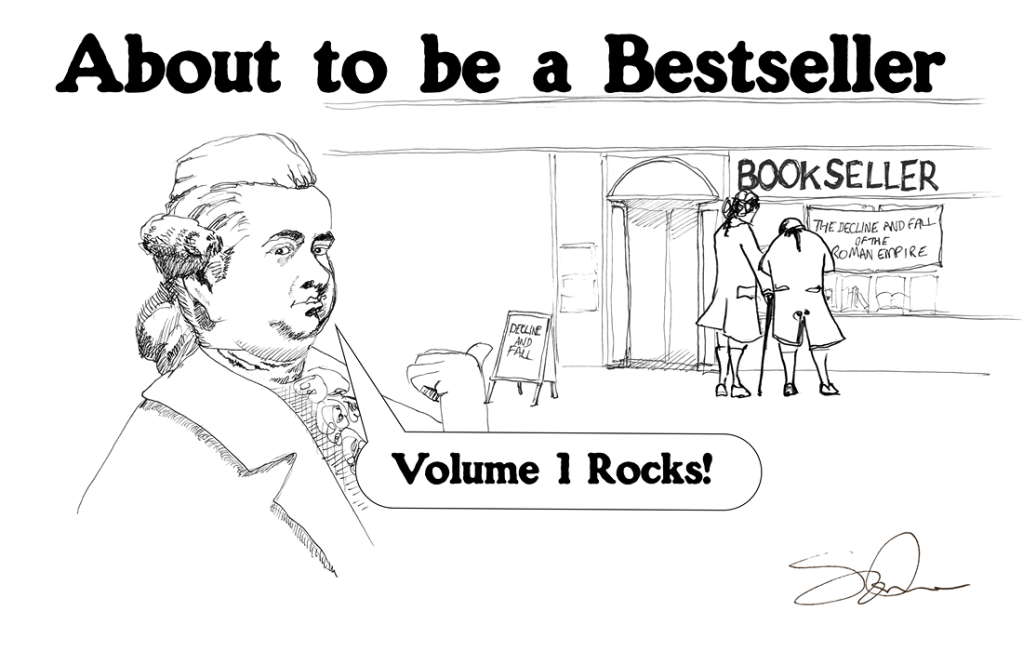
On Tuesday 17 February it will be the 250th anniversary of a masterpiece in scholarship and literature, a book, or rather a work in six volumes, which many will know, but only a few have read. Of course…you all knew! It’s Edward Gibbon’s Decline and Fall of the Roman Empire, or to help my Search Engine Optimisation and give it its full title: The History of the Decline and Fall of the Roman Empire. Over the coming weeks, you can expect to see stories marking this anniversary all over t’internet. It’s that big of a deal. And I’ll be bringing the Genius Fan perspective to that endeavour.
Edward Gibbon’s Masterpiece
As achievements go, Gibbon’s Decline and Fall (to give it its shortened name) is absolutely gigantic. It’s galactic-in-size considering this was before computers, the internet and wordprocessing. It’s a testimony to his intelligence, to his love of reading as a child and throughout his life, to his capacity to store and retrieve information, to his ability to read in multiple languages, including Latin (fluent) and Greek (not so fluent), to his commitment to the enterprise and his discipline in carrying on when maybe things got tough, and to artistry in his ability to write beautiful prose and to his respect for ancient sources when they didn’t know any better and to his scepticism when dealing with his contemporary historians who he felt should have known better, and to his stamina when his health wasn’t strong and to his singlemindedness when there was no wife behind him to roll her eyes or urge him on and to his warmth and geniality which enabled him to step away from his books and socialise keeping him on track with his project and preserving his health of mind. I could go on.
Let me give you some bullet points and then a summary of his work:
Scale of the work
- Full title: The History of the Decline and Fall of the Roman Empire
- Author: Edward Gibbon (1737-1794)
- It’s a 6 volume work
- There are 71 chapters
- Each volume has approx 570 pages*
- There are 8,000+ footnotes
- Vol 1 published 17 Feb, 1776
- Vols 2 & 3 published 1781
- Vols 4-6 published 1788
* It’s an average from my own Everyman Library edition (1993)
Summary
The work examines the history of the Roman Empire, suggesting the decline began in 180 CE, at the end of the period known as the Five Great Emperors. Across 71 chapters Gibbon describes the lives and activities of all the rulers of the empire, up to and beyond the split into east and western empires. He says the reason the empire ‘declined and fell’ was down to a weakening and eventual loss of civic virtue and political stability – not particularly controversial. But he also said this internal erosion was made worse by the growth in popularity of Christianity – now that was very controversial, because it suggested a focus on the afterlife (a Christian preoccupation) could weaken the Eighteenth century population of Britain.
Understand the Roman Empire, understand Britain’s future
I’m speaking to everyone in the world, here (though I admit there are some who haven’t discovered this blog, yet): the Romans, their language, society, empire are the platform on which Europe built itself. So how it came to an end and what replaced it are questions people have pondered over the centuries. (It’s still a process discussed today.)
In the Eighteenth century, the age of reason, people (mostly men) were exploring issues such as progress, the future, the best way to organise society and so on. That was the Enlightenment way (for Enlightenment, think Eighteenth century). Reflecting on the Roman Empire, the educated and enlightened man of the Eighteenth century saw parallels with England’s (Britain’s) trajectory as an emerging global empire, with a stable political structure, limited monarchy, flourishing literature, arts and science – possibly a modern day (their modern day, that is) Roman Empire.
Their equation goes like this: If Britain and ancient Rome share so many similarities then it might be possible to avoid the mistakes the Romans made, mistakes that led to the decline and fall of the Empire, thus ensuring the future of the emerging British empire.
The time span of Gibbon’s Decline and Fall
It’s 2026 and the Romans lived 2,000 years ago. Here’s some stuff you need to know.
- Roman Empire (27 BC – 1453 CE)
- Empire splits into East and West: 395 CE
- Western Roman Empire: 395 – 476 CE
- Eastern Roman Empire: 395 – 1453 CE
- Roman Republic (509 – 27 BC)
- Roman Kingdom (753-509 BC)
You can clearly see when the Roman Empire began, that was in 27 BC, but when did it start to decline? That occured in 180 CE with the death of the philosopher, general and emperor Marcus Aurelius, the last of what are known as the ‘Five Great Emperors’. The period dealt with in Gibbon’s Decline and Fall starts in 180 CE, then continues for two centuries to 395 CE when the empire splits into West and East. And after that, the Western empire trundled along until 476 CE, but the Eastern empire managed to continue for nearly another thousand years, to 1453.
Gibbon’s approach to history was new and different
Edward Gibbon’s project was to write an account of the collapse of the Roman Empire. Today, in the Twenty first century we call that history, but back in Gibbon’s day writing about the past had a different agenda (Who am I kidding – everyone’s got an agenda. We’re still viewing history from perspectives such as Marxist, Feminist, economic and so on.)
Up until the mid-1700s histories were seen as an exercise in revealing the intent of God, or reflecting on the impact of leaders, generals and thinkers. They may also have been simply setting out facts, dates, events in people’s lives with no interpretation (actually, that doesn’t sound so bad!) and then histories were also written to ‘talk up’ someone’s life and legacy. Gibbon did differently.
His writing is literary and a pleasure to read. He had read most of the available literature, much of that source material in the original Latin and Greek, and he questioned the truth behind the texts and the intention of the original authors. He cites the source of his information so people can check for themselves. And he interprets the events and creates a story. That story runs over 1,500 years.
Keep coming back to Genius Fan for more Edward Gibbon Goodness.
 Genius Fan
Eighteenth century fans: Leave your comments here