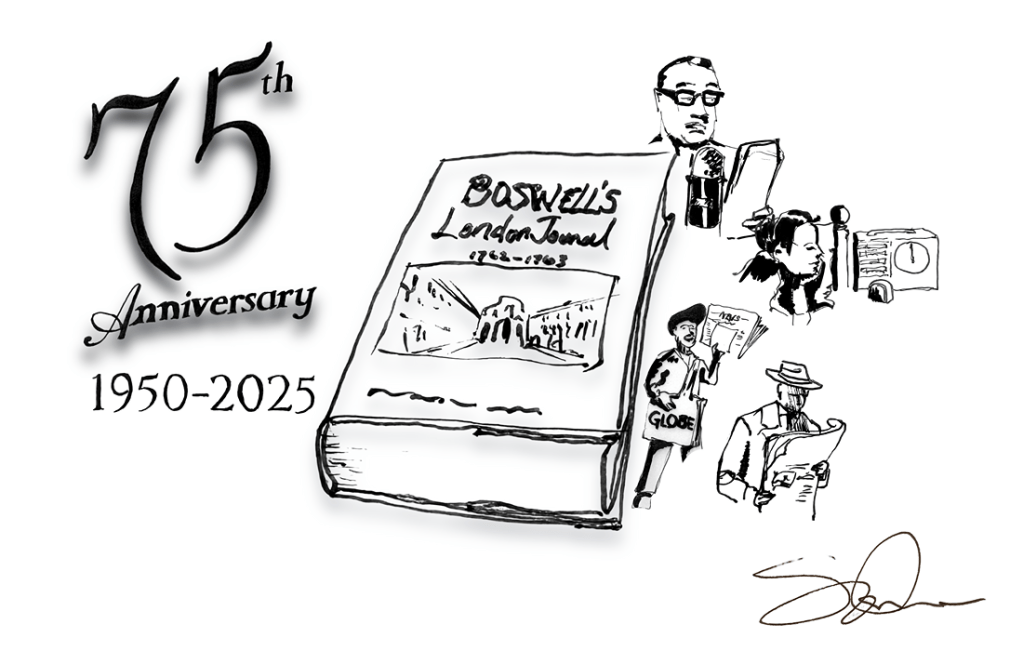
Happy Birthday to James Boswell’s “London Journal, 1762-63” – it’s 75 years old next month. Hurrah!!
QUOTE: “The Eighteenth century in this one volume of the journal is expressed more patently than in nearly all the other contemporary letter-writers and fiction-makers of the period put together. And the artistry! Make no mistake about it: this is literature.”
Moray McLaren, The Scotsman 4 December, 1950

What’s the London Journal all about?
The London Journal 1762-1763 was written by 23-year-old Scotsman James Boswell during his stay in London between November 1762 and August 1763. He’d do stuff* during the day, evening and night and then every couple of evenings he’d sit in his rooms and write up his notes on pages which have become known as his London journal. These pages were ‘lost’ in the years after Boswell’s death in 1795 and then rediscovered in 1930, purchased by Yale University in the US, and then edited for publication into the book we know, celebrate and love today.
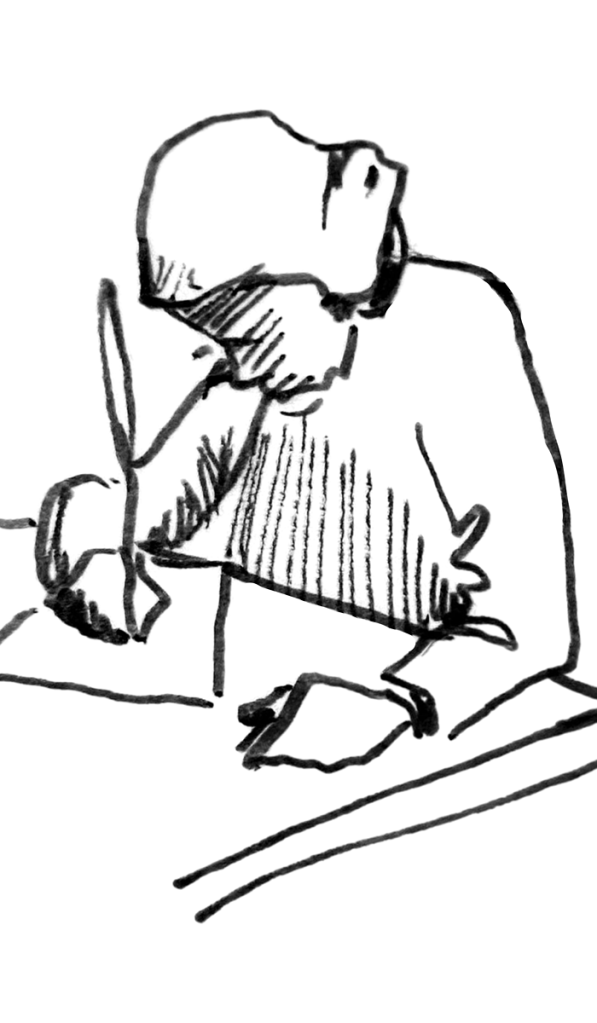
Back in 1762 though, there was probably no better place on Earth where a young man of Boswell’s energy could lead the life he wished, except maybe Paris, and his account sets out all the detail of the places he went, who he met and often what was said during his stay in London. This achievement was recognised by the many Twentieth century scholars and writers who read and reviewed the London Journal in the days and weeks around its date of publication.
British sales of the London Journal
The book went on sale in the UK on Monday 4 December 1950, just in time for Christmas and cost 21 Shillings. (Using the Bank of England Inflation Calculator, the 1950 sum of 21 Shillings – £1.05 in old British, pre-decimal money – is the equivalent of £31.26 today! Seems like a lot.) This was five years after the end of WWII, when eggs, milk, bacon and many other products were still being rationed. But people went nuts for the book! Frederick Pottle, in his Pride and Negligence: The History of the Boswell Papers, said “the British Book Society made it an alternative choice for its members for December 1950, which meant a distribution in the United Kingdom from that source of at least 10,000 copies.” He added that by the beginning of 1953 UK publisher William Heinemann has sold 110,000 copies of the London Journal (that includes the British Book Society and 1,050 limited edition copies of the De Luxe version).
US sales of the London Journal
Pottle (Pride and Negligence) said the London Journal was a great success. It went on sale for $5, on 6 November 1950, a month earlier than in the UK. US publisher McGraw-Hill undertook the printing and general sales amounted to 20,000 copies. Pottle also states that paper for an immediate second printing was ordered upon launch. In fact expectation of sales was so strong that the US Book of the Month Club arranged to take 200,000 copies as a free book in the first six months of 1951. “By the beginning of 1953 McGraw-Hill had sold 347,000 copies (this figure includes those distributed by the Book of the Month Club),” reported Pottle.
| New York Times Bestselling Books (Non-Fiction): 3 December 1950 – 28 January 1950 |
| 3 Dec | 10 Dec | 17 Dec | 24 Dec | 31 Dec | 7 Jan | 14 Jan | 21 Jan | 28 Jan | Book and Author |
| 1 | 1 | 1 | 1 | 1 | 1 | 1 | 1 | 1 | Kon-Tiki. Heyerdahl |
| 3 | 3 | 3 | 3 | 2 | 2 | 2 | 2 | 2 | Boswell’s London Journal. Pottle |
| 2 | 2 | 2 | 2 | 3 | 3 | 4 | 4 | 3 | Look Younger, Live Longer. Hauser |
| – | – | 9 | 6 | 5 | 5 | 3 | 3 | 4 | Out of this World. Thomas Jr. |
| – | – | 5 | 4 | 4 | 4 | 5 | 5 | 5 | The Hinge of Fate. Churchill |
You can see how the London Journal held its position near the very top of the most popular general fiction titles bought for all of December 1950 and January 1951. But it was never able to knock from the top spot Thor Heyerdahl’s exciting adventure tale Kon-Tiki, in which he and a team sail a vessel from Peru across the south Pacific to Polynesia.
Why did they read a journal that was 177 years old?
Why would some Eighteenth century Scotsman’s journal be so popular in the Twentieth century? How would that compete for the interest of people who had only recently experienced the hardships of World War II? It says something for Boswell and his private journal that so many people wanted to read what he got up to. The post war years of the late 1940s, were not short on adventure, romance, mystery, crime, western and sci-fi novels and many of our literary phenomena date from those very years: Animal Farm, Nineteen Eighty-Four, The Naked and the Dead, Gormenghast and The Big Sky. Part of the reason was that people back then were reading more, especially in newspapers, where they found a drip drip of news surrounding the discovery of the Boswell papers. And with that awareness there would likely have been an understanding of the prurient content in the journal. (I’ll get to that in this London Journal series of posts.)
*Stuff Boswell did in London 1762-1763
I’ll go into more detail about what Boswell did in coming days, but here’s a few bullet points of Eighteenth century-style activities to whet your appetite:
- Took rooms in Downing Street (UK Prime Minister lives there today)
- Socialised across London, including Charing Cross and Convent Garden
- Went parading and ‘hat-doffing’ with aristocrats in Vauxhall Gardens
- Became a regular at coffee houses Chad’s, Bedford’s and Beefsteak Club
- Found astonishing company, eg. Oliver Goldsmith and John Wilkes
- Tried to become an observer of men, as The Spectator (Joseph Addison)
- Attended ostentatious balls at Lady Northumberland’s House
- Had many sexual encounters with prostitutes
- Caught gonorrhea and confined himself for weeks to recover
- Met the great English writer Samuel Johnson (AN HISTORIC MEETING!)
- Wrangled over his future with father, top Scots judge Lord Auchinleck
- Agreed to study law in Utrecht, and then negotiates his own Grand Tour
Quotes from Newspaper Reviews in December 1950
The Manchester Guardian, 2 December, 1950
“Boswell’s Journal is a work that leads one to speculate whether life and society are far more fantastic than one had imagined or whether Boswell himself was a sane man whose alternating moods yet led him to the frontiers of the insane. Often he is himself puzzled by his own personality.” (p.4, article: “Boswell’s London Journal: An Exhibition of Genius,” B. Ifor Evans)
The Observer, 3 December, 1950
“To be as unselfconscious as Boswell is so alarming as to be lovable; and especially when unselfconsciousness is combined with a quenchless zest for life, and an enthusiastic power of admiration and affection. Never was there an egotist who thought so much and so highly of other people! Moreover, to dislike Boswell is to dislike ourselves.” (p.7 article: “James Boswell,” Lord David Cecil)
The Scotsman, 4 December, 1950
“The Eighteenth century in this one volume of the journal is expressed more patently than in nearly all the other contemporary letter-writers and fiction-makers of the period put together. And the artistry! Make no mistake about it: this is literature.” (p.4, article: “Young Boswell in London: Self-revelation in the Journal,” Moray McLaren)
New York Times, 5 December, 1950
“All the vigor, the crudity, the selfishness, the romance are here, caught forever by the genius of the young Scot who ran up and down the town “just like a wild colt.” Modern readers may well be forgiven if they cannot lay down his vivid account until the last page, for this is a journal destined to be one of the classics of its kind.” (p.204, article: “Young Mr. Boswell Goes to London,” James L. Clifford)
The Spectator, 15 December, 1950
“Incidentally some passages in the book are filthier than anything I have read anywhere, and, much as I dislike excisions, it seems to me open to grave question whether they should have been printed. It is surely sufficient to reproduce [the] monotonously frequent entry “picked up a whore” without proceeding to a detailed and often disgusting description of the operations that follow…” (p.666, article: A Spectator’s Notebook)
The Illustrated London News, 16 December, 1950
“It is a journal kept by Boswell when he was twenty two and had come upon the town with a very small allowance from his father, on which he attempted to cut a dash. It gives one an interesting picture of the London scene, so far as Boswell was able to survey it, and there are glimpses of many eminent persons forecasting the sketches he was later to embody in his great work [The Life of Samuel Johnson]. But fascinating and repulsive is the picture it gives of the young man himself.” (p.990, article: “Boswell’s Life of Boswell,” Sir John Squire)
The Rugeley Times, 16 December, 1950
“…the journal gives little flashes of what London life in the 18th century was really like. How Londoners in a coffee house really talked, what his landlady really said when Boswell gave her notice. What line was shot in those days by a scrounger in a public house. The journal is the revelation of one man’s inner heart, but it is also the daily journalism of a reporter with an exceptionally open eye and an exceptionally pointed pen.” (p.5, article: “Biographer of the Great Dr Johnson: Discovery of Boswell Manuscripts,” JP Mallalieu, MP (from his review in the Daily Express))
The Times
Weirdly, I’ve been unable to find a Nov/Dec story or review of the London Journal in The Times.
NOTES
Pride and Negligence: The History of the Boswell Papers, FA Pottle (1982)
Newspaper research:
New York Times, The Spectator
National Library of Scotland
Newspapers.com
 Genius Fan
Eighteenth century fans: Leave your comments here