I talk a lot about books in this Genius Fan blog, and my little library of nearly 200 volumes. But I also spend a lot of time online, fleshing out topics that I come across in books. Or elsewhere. Like the Eighteenth century military mapmaker Major-General William Roy, whose name I spotted carved into a concrete bench in Carluke recently (see the post I’ve got the Eighteenth Century Disease). Had I only consulted my books I still would have discovered reasonable biographical detail for his life – it turns out he’s a significant figure in Scottish and British history, especially military history post-Jacobite rebellion of 1745 – but the recent commemoration of his life I never would have discovered without the internet.
A quick Google search fleshed out what I already knew about William Roy (1726-1790)…he was a military mapmaker and made the first modern maps of mainland Scotland. And Britain’s Ordnance Survey organisation was set up the year after his death, following the work he did on a geodetic survey (surveying taking into account curvature of the earth) to establish the positions of London and Paris with greater accuracy.
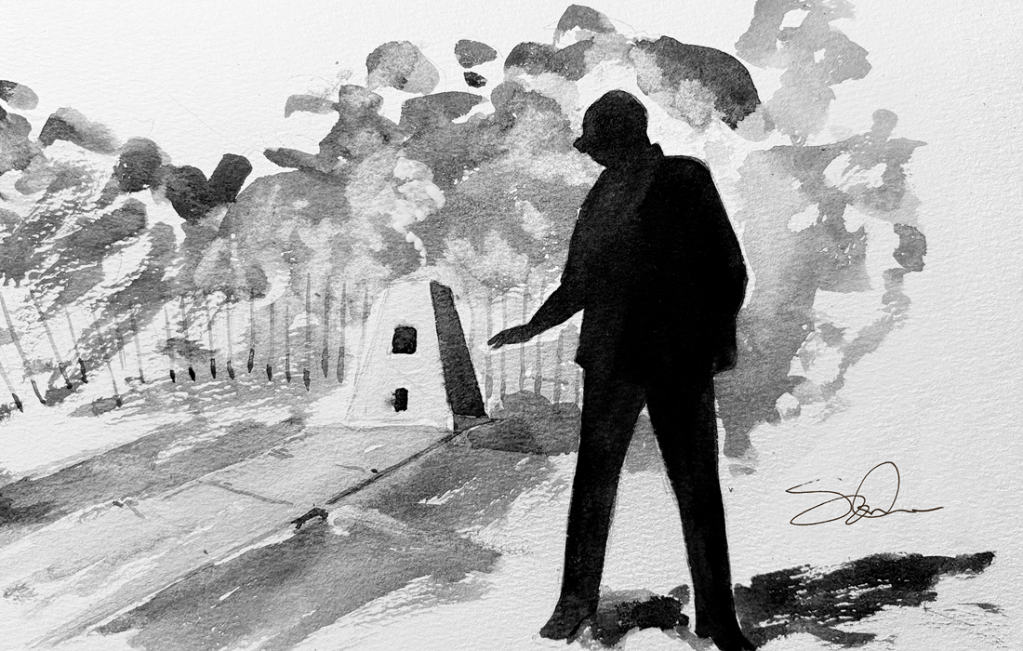
I discovered that in 1952, a triangulation pillar had been set up near the location of his home at a secluded place called Milton Head, down a narrow and leafy lane, halfway between Carluke and the Clyde river. Of course, I set off to find it. It’s set into a pink-gravelled clearing with an access path and a bench surrounded by a picket fence and trees. You would never know it was there unless you set out to find it. The little plaque on the pillar reads:
HERE STOOD MILTON HEAD THE BIRTHPLACE OF MAJOR-GENERAL WILLIAM ROY, 4TH 1726 – 30TH JUNE 1790 FROM WHOSE MILITARY MAP OF SCOTLAND MADE IN 1747-1755 GREW THE ORDNANCE SURVEY OF GREAT BRITAIN
It was perfect conditions to enjoy that visit, for although there was no foundation, remnant, relic, artefact, groundwork or anything like that, the effort that had been created to mark the birthplace of Roy had resulted in a little sanctuary, away from all the noise and sights and other sensations of the Twenty First century. The mid-September, later afternoon heat, light breeze, rustling of trees, crunching of gravel and scent of the fields nearby…perfect conditions for a history reverie.
 Genius Fan
Eighteenth century fans: Leave your comments here