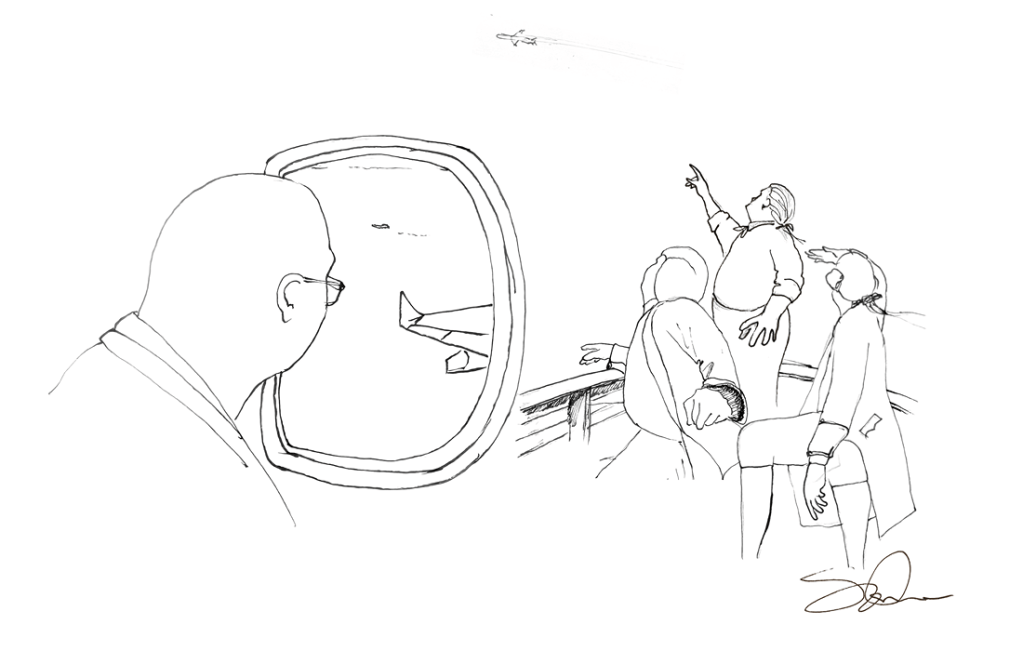
On Wednesday 18 August 1773 a little boat sailed across the Firth of Forth from Leith to Kinghorn, carrying passengers James Boswell, the Scottish lawyer and writer, his servant Joseph Ritter, the hugely famous Samuel ‘Dictionary’ Johnson, and Scots advocate William Nairne. On Thursday 17 July 2025, I departed Edinburgh airport on flight BA8711 into an east wind, looped anticlockwise into Fife and out through my little window I got a wonderful view of the Firth of Forth below as the plane climbed, banked left and headed due south to England. There and then everyone on that side of the aircraft could see down the Forth estuary and out into the North Sea, and who knows if I was the only person imagining Boswell and his companions in that little boat. The travelling companions set off from Leith, the nearest port to Edinburgh, on the tour which would become famous, for the two accounts that were written by Boswell and Johnson (previous post). Half way through the crossing, a distance of about 5miles, Johnson asked to make a small detour and to stop off at an island they were approaching so they could explore. That island’s called Inchkeith and I could make it out in the distance as my plane turned and headed south. That’s when my time travel reverie happened.
Johnson wrote in his account, “As we crossed the Frith of Forth, our curiosity was attracted by Inch Keith, a small island, which neither of my companions had ever visited, though, lying within their view, it had all their lives solicited their notice. Here, by climbing with some difficulty over shattered crags, we made the first experiment of unfrequented coasts.” (Such clean and August prose from Johnson.) Boswell wrote in his account, that Johnson remarked, after exploring the island and its little 16th century fort, “I’d have this island. I’d build a house, make a good landing-place, have a garden and vines and all sorts of trees. A rich man of a hospitable turn here would have many visitors from Edinburgh.” And Boswell continued, “When we had got into our boat again, he called to me, “Come now, pay a classical compliment to the island on quitting it.” I happened luckily, in allusion to the beautiful Queen Mary, whose name is upon the fort, to think of what Virgil makes Aeneas say on having left the country of his charming Dido: “Invitus, regina, tuo de littore cessi.” [Trans. “Unwillingly, O queen, I left your shore.”] “Very well hit off,” said he.” These little dialogues, that Boswell so brilliantly drops into his account, are part of what make his account of their tour of Scotland so readable and evocative.
Notes
To the Hebrides: Samuel Johnson’s ‘Journey to the Western Islands of Scotland’ and James Boswell’s ‘Journal of a Tour to the Hebrides’, (ed) Ronald Black (2007)
This is the latest edition of the two travel accounts and it’s full of excellent notes (999 of them) that flesh out the story with mini-biographies of people they meet along the way, explanations and clarifications for the contemporary reader.
 Genius Fan
Eighteenth century fans: Leave your comments here