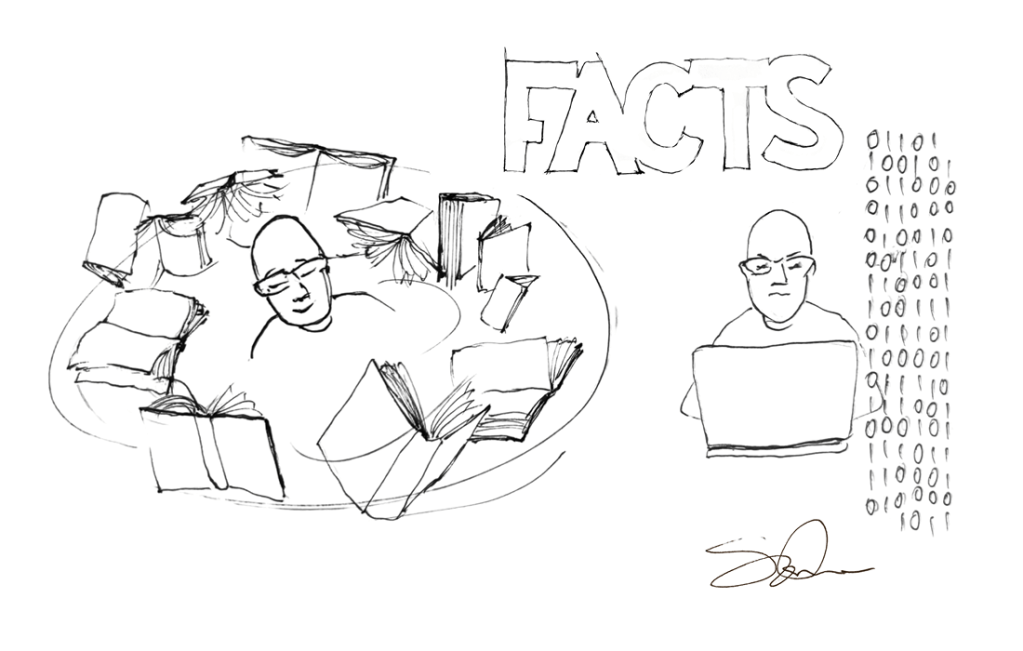
Which do you trust more: Book facts or internet facts?
When I began the Genius Fan blog my plan was to create illustrated stories based around: ‘James Boswell and his life and times in the Eighteenth century’. The objective was to reach like-minded fans of Boswell and the Eighteenth century. I expected to do that by ‘pulling out’ interesting anecdotes, nuggets that litter scholarship of that century, that I discovered in books that I bought and read (most of which I have yet to read, ahem). That process was steering me away from my mobile phone, off the internet, out of social media, and pulling me into books, made of paper, consisting of pages which I turned, and lines of text which my eyes would re-accustom themselves to looking at for an hour or more, and containing concepts which my mind would ruminate over and create new neural pathways etc. So Genius Fan was predicated on the reading of books. Not the internet. That meant all (most of) my references in the Notes section at the bottom of each post were of books: title, author and year of publication. Thinking about it now, I have to admit that I was corroborating my understanding of some topics by dropping into the internet (often Wikipedia…which I think is great, btw), but choosing not to add any reference, by way of internet links, in my Notes. (In ‘corroborating’ I’m fleshing out my background or hinterland understanding of a topic, which I feel is often needed to write a post that has a suitable amount of context.)
That’s why I think I’ve become…not so much a book snob, but an information-provenance snob. It feels like I would rather use information from a scholarly work published in a book…because it’s in a book, than from an internet source which was written this year. And it gets to ridiculous lengths. Just look at the James Beattie post in which I cite eight books dating from 1936 to 2007. That now feels like show-offery. And then, we know the internet is full of sites giving information on every topic under the sun, written by individuals (or nowadays it could be AI!) about whose practice we know very little: knowledge, authority, qualification, accuracy/fact checking, citation, bias and so on, yet I’m fully aware there are plenty of what one might call ‘personal’ sites out there, just like my Genius Fan blog, which I believe to be quite accurate – based on my own knowledge and understanding of the Eighteenth century. (There are other sites and services which I use that do have an established pedigree, like JSTOR – see what I did, I linked to it right there in the text. That’s personal growth. Smiley face.). Now look at my most recent post (which I admit was ‘light’): Show me a Sign: an Eighteenth Century Bridge. I relied 100 per cent on internet sources for that and it wasn’t at all satisfying to write. So, from now on, I’m thinking more about where I get my information and how I cite its use. I still favour a book (or an online scholarly article) that’s been reviewed, edited and approved, but i’m going to add in links to internet sources so readers can follow up for themselves.
 Genius Fan
Eighteenth century fans: Leave your comments here