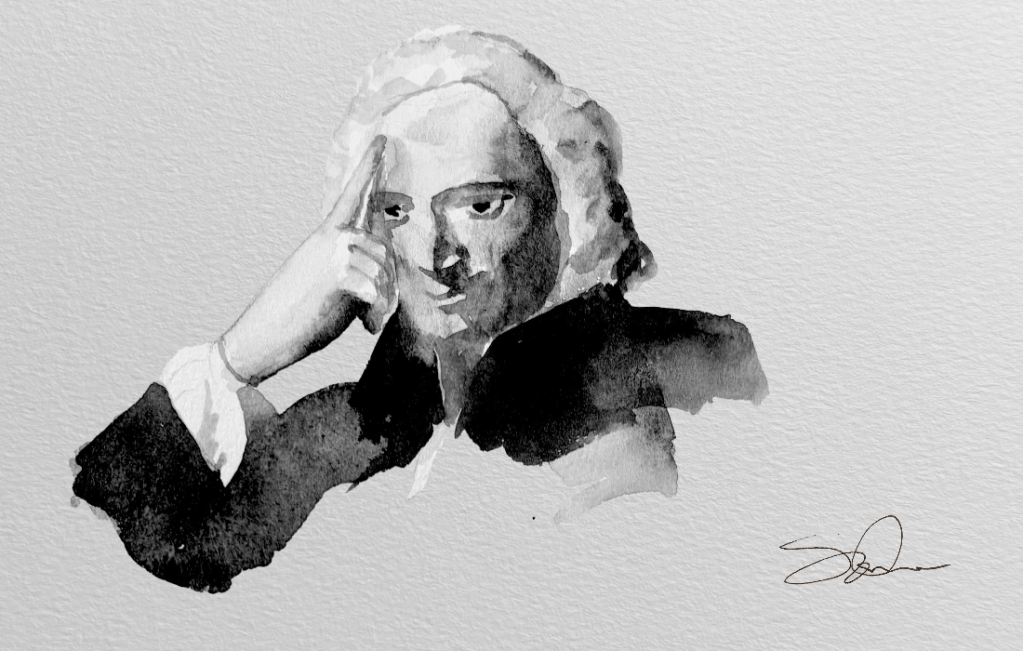
There are so many clever ways to start a blog post about Laurence Sterne. Here’s the Genius Fan method: “Never heard of Laurence Sterne? Stop what you’re doing RIGHT NOW, run – sprint if your knees will bear it – to the nearest book shop and buy a copy of his Eighteenth century novel Tristram Shandy. Buying and reading this book will be one of the greatest achievements of your life.” The effort required to read this book – it’s not that difficult – will pay off greatly by way of exercising and rewiring your brain. Just take the time to read it. It was published in instalments, the first two came out in December 1759. It’s perhaps the most extraordinary example of the novel, an art form that emerged in the Eighteenth century. It’s a bold claim considering that same year, 1759, Voltaire’s satire Candide was published (January) and translated into English a couple of months later and Samuel Johnson’s fable Rasselas, also published (April). I knew about Candide and Rasselas in 1759, and was excited when I saw that Tristram Shandy came out the same year. But then I remembered I’m always catching up when it comes to learning about history: turns out in 2012 Shaun Regan published a collection of essays Reading 1759 in which we discover a whole bunch of important works appeared that year including Adam Smith’s The Theory of Moral Sentiments, Edmund Burke’s Annual Register, Diderot and D’Alembert’s Encyclopedie and other ‘stuff’. (I’ve just checked and I’ve got a book called 1759: The Year Britain Became Master of the World on my bookcase! It was a good year, apparently.)
Tristram Shandy is fun, funny, interesting, eye-opening, bawdy and modern. It’s about a man called Tristram who attempts to tell his life story. He doesn’t succeed, but he entertains with scenes from his family life. And Sterne tells the story using techniques we regard today as Modernist (absurd story devices, text layouts and page design etc – all complementing the narrative). I thought the 1700s was in some way less sophisticated or evolved than the 21st century, but once again I discover history is a cycle and there seems to be nothing new, just the same, but different. Sterne (1713-68) was born in Ireland and in adulthood became a minister in Yorkshire. He was 46 years old when Tristram Shandy was published, he wrote one other novel, A Sentimental Journey, published in 1768 and I’m reassured to learn that the inimitable James Boswell met Sterne in 1760.
Notes
The Life and Opinions of Tristram Shandy, Gentleman, Laurence Sterne (1759)
Candide: or, All for the Best, Voltaire (1759)
The History of Rasselas, Prince of Abyssinia, Samuel Johnson (1759)
Reading 1759: Literary Culture in Mid-Eighteenth-Century Britain and France, ed. Shaun Regan (2012)
1759: The Year Britain Became Master of the World, Frank McLynn (2004)
A Sentimental Journey Through France and Italy, Laurence Sterne (1768)
 Genius Fan
Eighteenth century fans: Leave your comments here