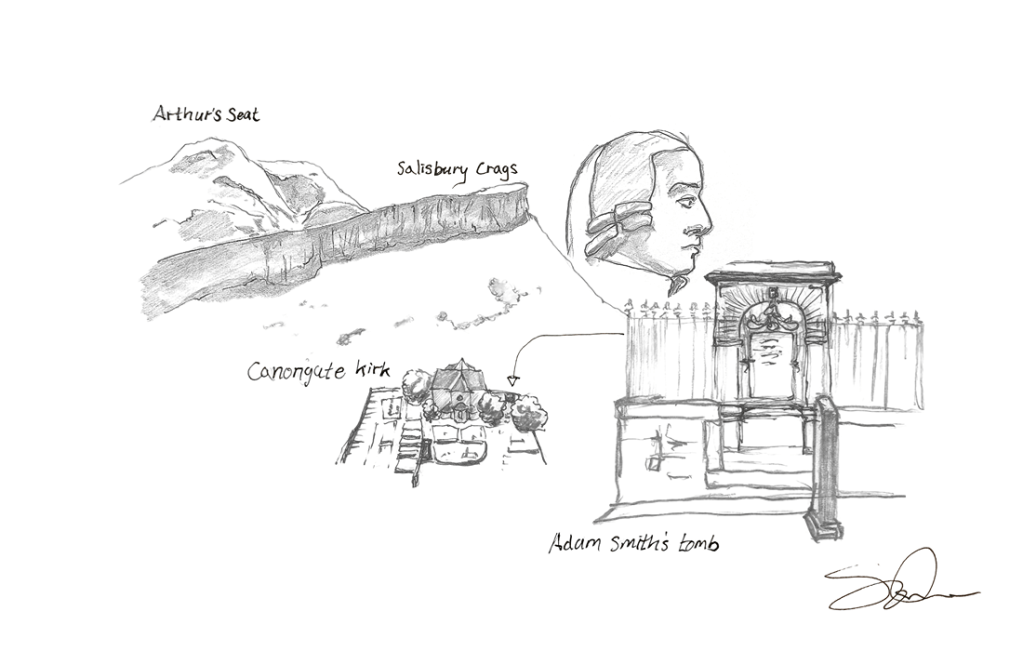
Go to Edinburgh. Go to the Canongate. Make your way downhill. Look out for the Canongate Kirk on your left. Enter the Kirk gates – they should be open during the day. Turn left inside the gates. Follow the path. Keep walking round to the left. You will see a railed enclosure which protects a gravestone set into the wall. This is the tomb of Adam Smith, the Eighteenth century Scots economist and philosopher. That route will get you to the tomb in the shortest time, but there’s lots to see in the kirkyard that makes it worth a stroll. My route took me through the gates to the right and anticlockwise around Kirk itself. That’s when I saw a distressed young woman sitting on a grave, squabbling into her mobile phone and struggling to control the French bulldog pulling at its lead. It was a beautifully warm and sparkling late spring morning in Edinburgh, but the young woman’s argument turned tearful and broke the spell for visitors, strolling among the gravestones and ticking off their list of ‘Celebrities Interred in this Churchyard’ (as described on the noticeboard at the entrance).
Smith had a fascinating friendship with Scotland’s greatest (indeed, the English language’s greatest) philosopher and writer, David Hume and his most famous work, The Wealth of Nations (full title: An Inquiry into the Nature and Causes of the Wealth of Nations), was published in 1776, just months before Hume died. It’s in the Wealth of Nations that Smith famously described the Pin Factory example to illustrate his theory of the division of labour, that is, by dividing up the whole process of making pins into its constituent parts and allocating a man to each activity, the factory is able to output 48,000 pins per day, instead of less than 200 per day if a single person makes each pin from start to finish. I found myself chewing over Smith’s example as I hurried back to Waverley train station after a company ‘away day’ introducing a drive to use AI to automate work processes, thus making our company more competitive.
Notes
The Infidel and the Professor: David Hume, Adam Smith, and the Friendship That Shaped Modern Thought, Dennis C Rasmussen (2019)
 Genius Fan
Eighteenth century fans: Leave your comments here