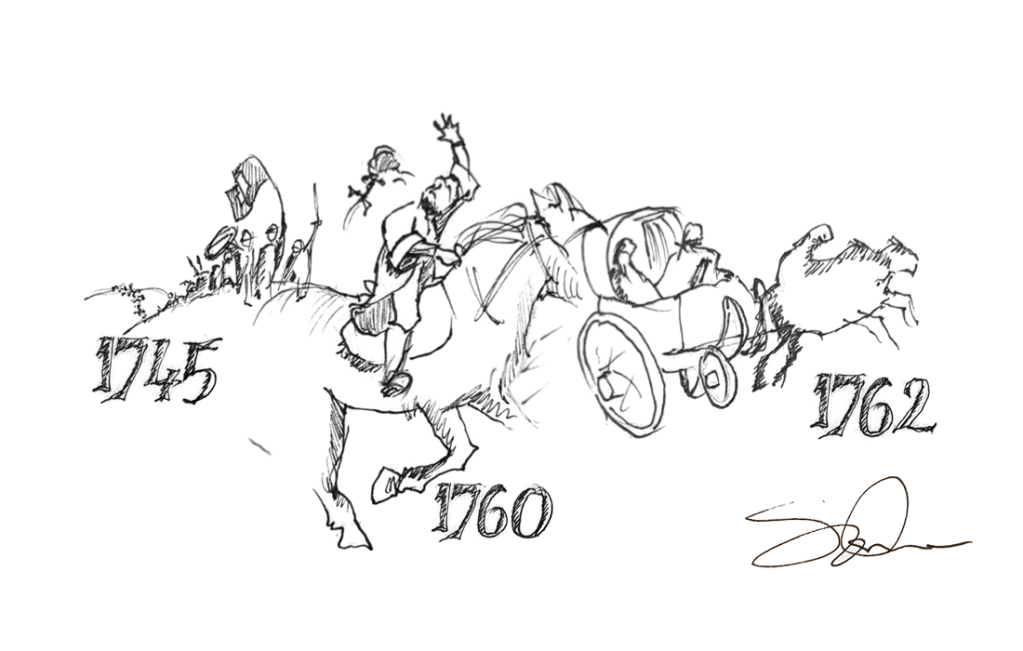
There were only three ways to travel between Scotland and London in the Eighteenth century: by foot, on horseback or by wheeled carriage. (Actually, you could take a boat, from Leith for example, but it wasn’t until the 1850s when a person could travel by rail out of Scotland and into the nation’s capital.) Walking to London was rarely done, though hundreds of Highlanders walked as far as Derby in late 1745. On their minds? Their leader Charles Edward Stuart and a Jacobite restoration. On 1 March, 1760, Scots teenager James Boswell made a sprint to London by horse. He changed his mount at Carlisle and rode the remaining 320 miles in just two and a half days, a fast journey which surely knackered his horse. On Boswell’s mind while he tore south was an intense desire to convert to Catholicism.
Boswell made a second, and this time parentally-approved, trip to London in 1762. He left Edinburgh on the morning of Monday 15 November, travelling by chaise, a two-wheeled carriage, pulled by two horses, one of which carried on its back the postillion rider (the driver). Boswell was accompanied by Alexander Stewart, an employee of the East India Company, on a journey that lasted five days, with overnight stops in Berwick-upon-Tweed, Durham, Doncaster and Biggleswade. That’s a tough journey and you can read about it in a handful of short entries in his private journal published in 1950 as Boswell’s London Journal 1762-1763. On Boswell’s mind during that journey was securing a commission in the Guards and spending as much time as possible soaking up the entertainments of the capital.
Notes
James Boswell: The Earlier Years 1740-1769, Frederick A Pottle (1984)
James Boswell. London Journal 1762-1763, (ed) Gordon Turnbull (2014)
A Life of James Boswell, Peter Martin (1999)
 Genius Fan
Eighteenth century fans: Leave your comments here