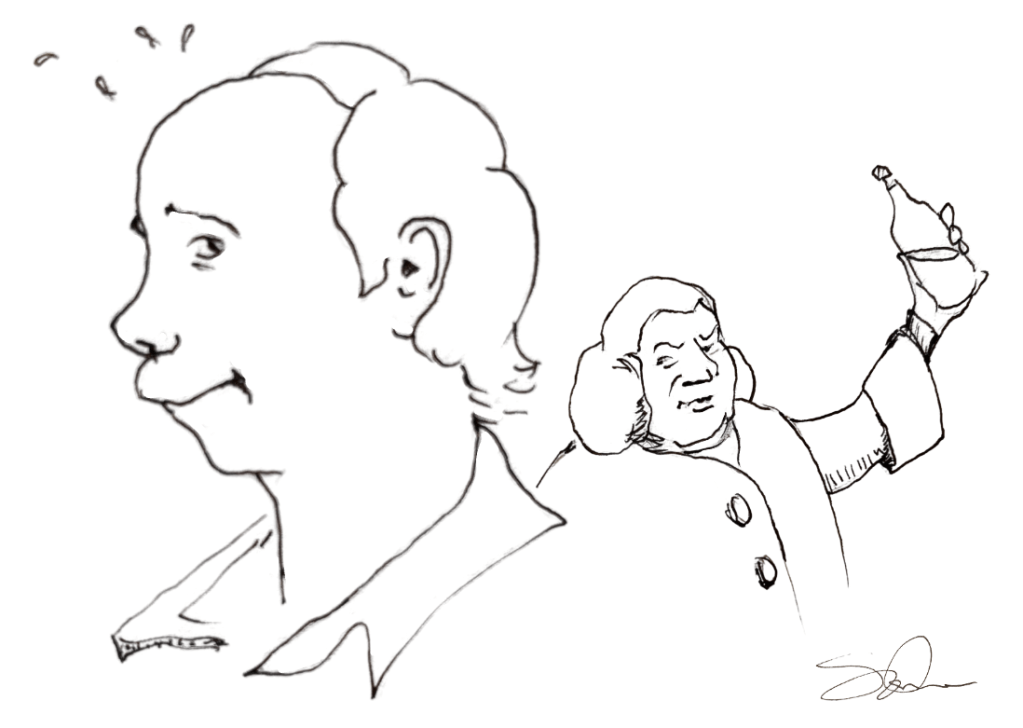
One morning in 1762, the soon-to-be-famous Irish writer Oliver Goldsmith, was woken by an urgent rapping at the door of his London lodgings.
Oliver Goldsmith was bad with money
“Knock, knock!” Upon opening up, there was his landlady, threatening to bring the bailiffs unless he settle his many weeks of unpaid rent. Goldsmith was not good with cash; he earned, borrowed, gambled, lent, lost and gave away money. At that point he had none. The bailiffs would take him to a ‘sponging house’, informally imprisoning him, to sharpen his mind on how to find the funds, but in pursuit of a quicker resolution his landlady allowed him to send a message.
Goldsmith trusts in Samuel Johnson
It was to friend and celebrated writer, Samuel ‘Dictionary’ Johnson, that Goldsmith appealed. Johnson sent a guinea by return with a promise he’d follow soon, once he had dressed himself! He lived a short distance from Goldsmith’s Wine House Court lodgings, off Fleet Street, and when he arrived he found his friend working his way through a bottle of Madeira, which he’d bought with Johnson’s guinea. The resolution? Johnson asked Goldsmith for any manuscripts which could be sold to raise the funds. He was given one, which Johnson took to publisher John Newbery, who paid a £60 advance, which enabled Goldsmith to pay off his debt. The manuscript was Goldsmith’s novel The Vicar of Wakefield, eventually published in 1766.
Johnson wanted to impress Goldsmith
Johnson held a great liking for Goldsmith, despite all the Irishman’s shortcomings. They first met on 31 May 1761, after Goldsmith invited the great man to his lodgings for supper, an exceedingly precocious act for someone so little known. The Reverend Thomas Percy, also invited to sup that evening, described how he accompanied Johnson on the walk to Goldsmith’s place. He said Johnson was wearing a new suit of clothes and new wig and this was a surprise considering he was well known for a shocking lack of attention to his appearance (he was usually unwashed, wore the same clothes for weeks and was generally dishevelled). When Percy asked what prompted the change, Johnson replied, “Why Sir, I hear that Goldsmith, who is a very great sloven, justifies his disregard of cleanliness and decency, by quoting my practice, and I am desirous this night to show a better example.”
Oliver Goldsmith: 10 Nov 1728 – 4 April 1774
Notes
A Notable Man: The Life and Times of Oliver Goldsmith, John Ginger (1977)
Oliver Goldsmith: A Biography, Washington Irving (1849)
In Our Time: Oliver Goldsmith, BBC Radio 4 (Feb 2025)
 Genius Fan
Eighteenth century fans: Leave your comments here