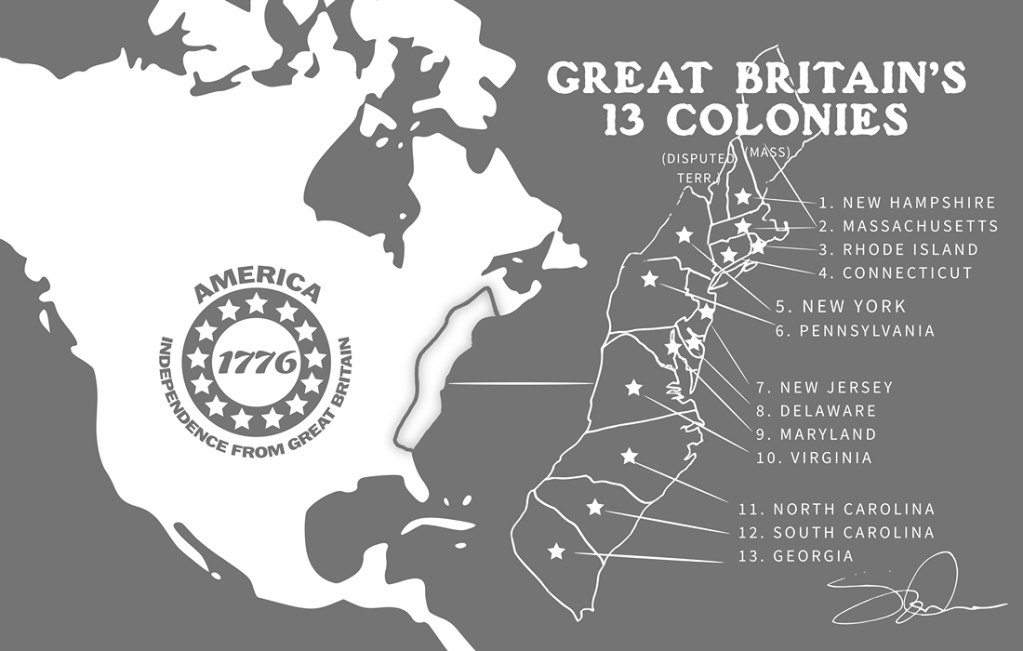
Back in 1976 I was going into my last year at primary school and our teacher introduced us to the American Bicentennial: 200 years since the American Declaration of Independence. Here I am in 2026, half a century later, reflecting back on how little I knew or how poorly I understood the whole American independence event. It’s only since I’ve been reading books about Eighteenth century history that I realise I had made so many assumptions, skipped over so much detail and never questioned the childish stories I created in my head back when I was 9 years old. So in this post I’m revealing the things I didn’t know. I expect many of my readers didn’t know them either.
- American independence refers only to the 13 colonies. ‘America’ in this context meant the 13 British colonies which stretched down the East coast from New Hampshire in the north down to Georgia in the south. (See the illustration for this post.) These colonies began as individual settlements of dozens of people which grew into villages, towns and by 1776 some cities. There were more than two million people living in the colonies in 1776.
- Not all colonies were involved. The 13 colonies were a very small part of the north American continent – just that strip along the east coast. But there was also a gigantic inland territory (think of it as occupied rather than colonised since it’s population was extremely sparse, between 50,000 and 100,000) known as New France which encompassed Newfoundland in the north, across the Great Lakes to central (modern) Canada and south down the Mississippi. Britain took control of this land in 1763, in a settlement called the Treaty of Paris, following the French and Indian Wars (1756-1763). The population of this huge area was either loyal to the British crown or neutral.
- The colonists identified as Englishmen, not Americans. In the 1770s, the colonists considered themselves English…just living in a colony across the Atlantic ocean.
- Not everyone wanted independence from Britain. It’s been estimated one third of people were loyalists (to England – Britain), one third were patriots (in favour of independence) and one third were sitting on the fence to see which way the war would go before taking a side. (A majority of colonists did NOT want independence.)
- It all began before 4th of July 1776. It didn’t just start on this hallowed date. Discontent among colonists started to become noticeable after the British victory over the French in 1763. That war cost a lot. Many in Britain felt it only fair that the colonists should contribute. And this is really where all the tensions began. Acts of Parliament levied taxes on the colonists and they weren’t happy. Remember the Boston Tea Party protest in 1773.
- The colonists and the British were at war BEFORE the declaration of independence. This is called the Revolutionary War (1775-1783). It starts with the Battles of Lexington and Concord (19 April 1775), the first volley of which was immortalised in US poet Ralph Waldo Emerson’s phrase ‘the shot heard round the world’. It’s for this war that George Washington dusted off his uniform (he distinguished himself fighting for the British in the French and Indian War, 1756-1763) to become commander of the American Continental army in 1775.
- Opinion in Britain was divided. You might have thought that the British people would automatically want to defend their colonial possessions. Not the case. The policy of King George III and his Prime Minister Lord North was to fight to maintain control and ownership. Others were more conciliatory, such as Edmund Burke. And others were openly in favour of American independence, among them John Wilkes, the Marquess of Rockingham and Charles James Fox. Let’s not forget Thomas Paine, whose pamphlet Common Sense, published in January 1776, was a blockbuster read by seemingly every colonist.
- This was before the Wild West. The classic Wild West, of Cowboys and Injuns, wagon trains heading west, saloons, gold rushes, gun slingers, all that stuff we know from the movies…all that came well into the Nineteenth century.
 Genius Fan
Eighteenth century fans: Leave your comments here