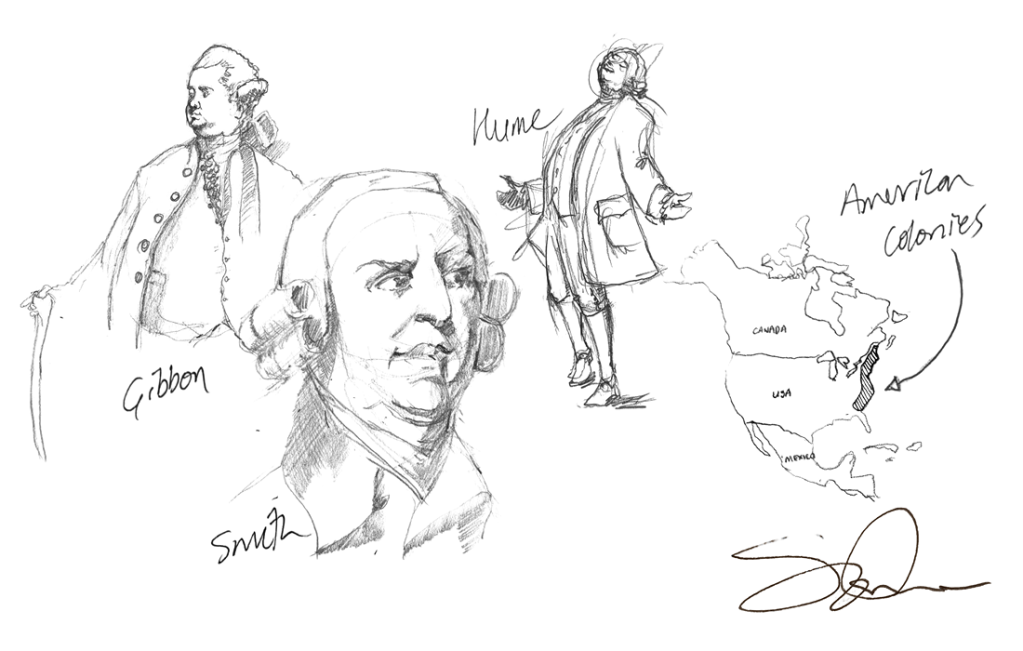
The coming year, 2026, is a big year to celebrate things that happened in 1776. That is, it’s a big year for 250th anniversaries, and I’m going to highlight four big ones. If you read history then it’s likely you’ll know these – they’re the ones everyone talks about. Here at Genius Fan I’ll be breaking down these events in my own way, throwing in some literary history, some biography and some visits to see places that feature in these people’s lives.
Quite clearly those with interests around the world will have their own 250th anniversaries to mark, but for the development of European/Western civilisation, thought and achievement my four are pretty big. Here’s the list, in chronological order.
1. Edward Gibbon’s ‘Decline and Fall’
17 February, 1776: Englishman Edward Gibbon published the first of his six volume series The Decline and Fall of the Roman Empire, possibly the most famous history book in the English language. As the title says, it’s a story (a long one) of how the Roman empire weakened and then, after centuries, finally collapsed. Now, many of us have heard of this ‘book’, but the word on the street is, very few people have actually read it. And yet, despite its length, scope, and the fact much of his narrative has been rewritten by archaeology and discovery in the following centuries, it’s a work that’s worth reading because of Gibbon’s prose. His writing style is remarkable. I’ll be delving into the book as well as the life of Gibbon (1737-1794). He’s a fascinating character.
2. Adam Smith’s ‘Wealth of Nations’
9 March, 1776: The Wealth of Nations was published today. It’s another one of those books that many have heard of, but which most haven’t read. It was written by Adam Smith (1723-1790), a Scottish philosopher who many think of today as the father of modern economics. Legend has it that two centuries later, Margaret Thatcher (British Prime Minister from 1979-1990), kept a copy of this book in her handbag! Great story. The book’s full title is An Inquiry into the Nature and Causes of the Wealth of Nations. Essentially, Smith says that people are driven by self-interest (in the work they do, what they buy, how they live their lives and so on) and that if you remove as many controls from government as possible the result will be a thriving and prosperous nation. That’s classic Thatcher right there. Back in 1776 the book went straight to bestseller status, and it was highly praised by Smith’s great friend David Hume…who received a copy and was able to read it before he died later that year. Stories about Smith’s life and his ideas are coming in 2026.
3. American Declaration of Independence
4 July, 1776: We all know this date – it’s the day America declared independence from imperial Britain. It’s a pretty big deal for the USA each year, but I suspect President Donald Trump will go to town on the 250th anniversary to encourage national pride, flag waving and conversations about how the USA is the greatest nation on Earth. (Go for it, Donald, but you’re wrong! America IS amazing…but Britain is the most awesome nation.) Back in the mid-1770s the question over the future of the American colonies was big news, and the American Revolutionary War (1775-1783) occupied much of the brain power of Lord Frederick North (PM, 1770-1782) of whom it’s said, lost the colonies. Joining him on the stage of this momentous event are George Washington, and many other founding fathers, including…wait for it…Benjamin Franklin. And Yes, we’ll take a look at Thomas Paine and his 1776 pamphlet, Common Sense.
4. Philosopher David Hume Dies
25 August, 1776: David Hume, the great Scottish philosopher, died on this date. Frustratingly, he’s remembered today because of a so-called ‘infamous’ racist footnote. It seems this footnote is all publishers, broadcasters, journalists, museums, galleries, charities, activists, local authorities etc, want to talk about. But Hume (1711-1776) lived an extremely productive life – and most believe him to be the greatest philosopher to have written in the English language. His written legacy includes A Treatise of Human Nature (1733-1734), An Enquiry Concerning Human Understanding (1748) and bestselling, six volume A History of England (1754-1762). Next year, I’ll be ignoring that footnote and talking Hume up. His good nature, personal warmth, conviviality and intellect come through in many anecdotes from contemporaries. The French philosophes called him Le bon David (‘the good David’) and in modern surveys he regularly tops the list of favourite philosophers. I will most certainly celebrate the life of David Hume. Join me. (Oh and I’ll talk about his philosophy, too.)
There’s so much to talk about with these four anniversaries, I’m looking forward to getting stuck in. And I should say James Boswell is connected to Gibbon, Smith and Hume. He knew them all and I’ll be looking for comments in his diaries.
 Genius Fan
Eighteenth century fans: Leave your comments here