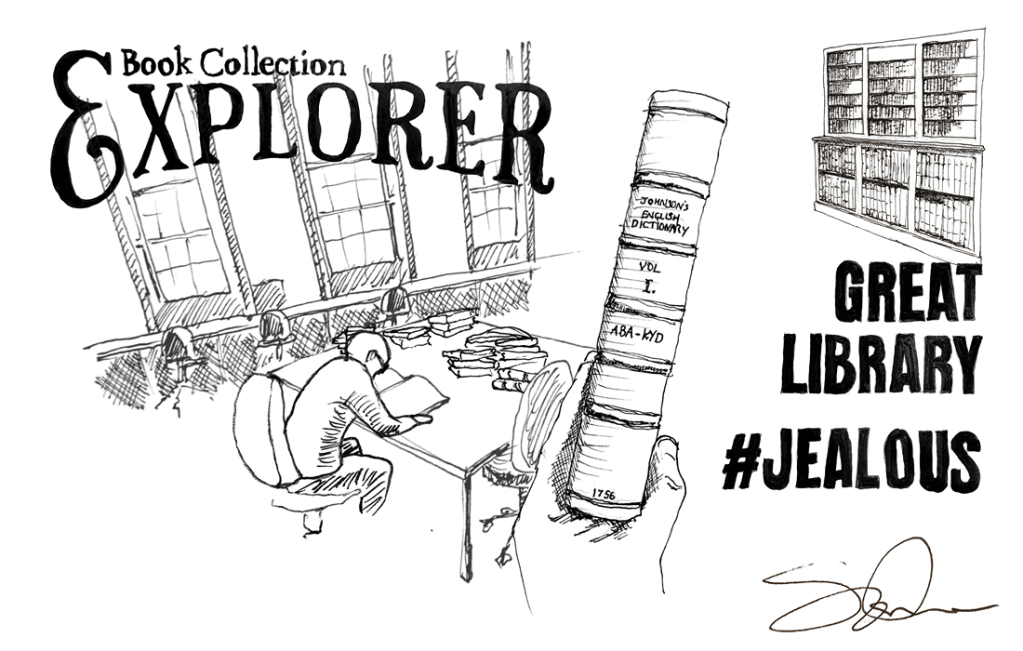
There I am, staring directly at an Eighteenth century book collection, arms length from titles someone in 1750 would consider a ‘must have’ in their home. This is William Smellie’s library, all 300+ volumes, half of which are reference works for a teaching physician and the other half…for leisure? Two hours from now I’ll leave the library and dash into the street to move my car before a traffic warden writes me a parking ticket. And at some point after that, a library assistant will replace the sample of Smellie’s books I’ve asked to examine, the bookcase will be locked, the door to the secure room will be closed, and locked, and Smellie’s books will return to its state of rest.
The Book Collection Explorer Series
This week is dedicated to the great Eighteenth century Scottish obstetrician, William Smellie. His personal library was bequeathed to Lanark after his death. You can still visit it and examine the same books he handled 275 years ago.
William Smellie’s Book Collection as it Looks Today
There’s an inscription on the top panel of the middle door of the top bookcase of the William Smellie collection (phew). It reads: ” The William Smellie Library. Bequeathed to Lanark 1763. Books rebound by admirers 1936-1939.” The project of repairing and rebinding the books to bring ALL volumes back to condition was mostly undertaken by Prof Miles Phillips of Sheffield University. According to Johnstone in his biography of Smellie (pronounced ‘Smyllie’) he did so at his own expense, commissioning Messrs. Northend of Sheffield and their craftsman Walter Slinn to carry out the work. Round the same time Lanark Town Council paid for a new bookcase to house the collection. That’s the one you can see today. This repair and rebinding work has unified the appearance of the books so they now all have the same tan leather cover, similar spine design and there’s a number at the bottom of each spine indicating the year of publication of the book.
So What’s in Smellie’s Book Collection?
I’ve been reading about the Eighteenth century for more than four years now and so I’ve got some idea of what a professional gentleman might have in his bookcase. Here are the standouts for me:
• Samuel Johnson’s Dictionary
Samuel Johnson, the famous Eighteenth century writer, wit and man of letters is also known as ‘Dictionary Johnson’ because of the ‘Dictionary of the Enlish Language‘ he published in 1755. Smellie has a copy, in two volumes, which was published the following year, 1756. It’s wonderful to handle that. (If you don’t know by now, Johnson and James Boswell are two of my favourite Eighteenth century figures and the reason I created the Genius Fan site).
• The Classics
Back in the Eighteenth century people read, learned from and enjoyed what today we call the Classics. Smellie was no different. Latin authors (in the original) Cicero, Horace, Virgil and then Homer (Alexander Pope translation, 1720 and 1725), Aristotle and others – they’re all in there. Smellie also has Latin and Greek grammar text books.
• Strawberry Hill Press
This was the printing house created by Eighteenth century aesthete Horace Walpole. Very first off the press, after launch in 1757, was Odes by, Mr. Gray (poems by Thomas Gray, 1716-1771). This copy is dated 1757 so it’s likely Smellie bought the volume soon after it was published. This may tell us that he was familiar in the bookstores of London where he was living and working at the time.
• Travel
Travel literature was increasingly popular at the start of the Eighteenth century and some interesting and well known titles pop up in the catalogue.
- Willem Bosman: “A New and Accurate Description of the Coast of Guinea” (1707)
- Daniel Defoe: “A Tour Thro’ the whole Island of Great Britain” (1748)
- Thomas Nugent: “The Grand Tour…of most of the Cities, Towns, and Remarkable Places of Europe” (1749)
- Jonathan Swift: The Works (contains Gulliver’s Travels) (1755)
• Novels
The novel is an Eighteenth century invention, and Smellie had a few, though no Samuel Richardson, Henry Fielding or Laurence Sterne. He has two novels by his friend Tobias Smollett:
- The Adventures of Peregrine Pickle (1751)
- The Adventures of Ferdinand Count Fathom (1753)
This is a tiny selection of books that jump out for me. There’s a book about magnets and magnetic theory, there’s a book about wine and grape growing, about astronomy and physics. And that doesn’t even touch on the medical and midwifery books. The library has a catalogue of all William Smellie’s books.
 Genius Fan
Eighteenth century fans: Leave your comments here