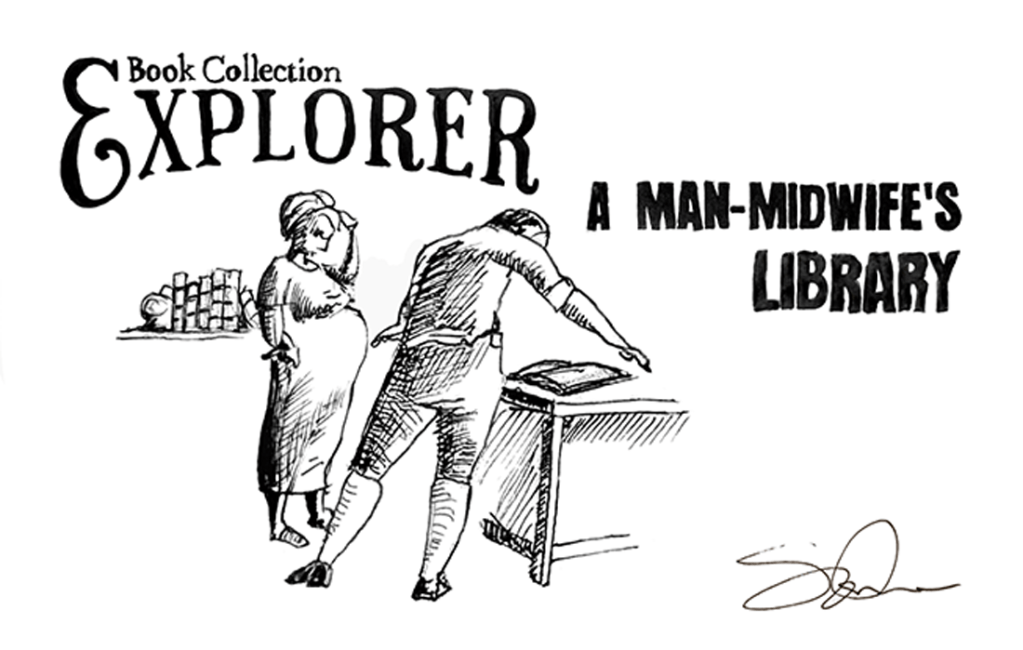
Keys in hand, librarian Elena Focardi makes her way to the locked door protecting the precious and valuable books at Lanark Library. I’ve come to see a book collection that’s 275 years old – owned by the town’s famous Eighteenth century son, William Smellie. He bequeathed his book collection, after his death in 1763, and over the centuries it’s been moved here and there until reaching its latest resting place: a secure room in the Lindsay Institute, the impressive building which houses the library on Hope Street.
The Book Collection Explorer Series
Each day this week I’m publishing a post about Lanark ‘notable’ William Smellie (1697-1763) and his book collection. It fell into disrepair over the generations, but its importance was recognised then secured for the future back in the 1930s.
Smellie’s Books Reveal the Challenge of Childbirth
It’s thought provoking to read Robert Johnstone’s biography, William Smellie, The Master of British Midwifery. He gives some accounts of difficult and unsuccessful deliveries which Smellie (pronounced ‘Smyllie’) encountered during his twenty years practicing as a physician and man-midwife in Lanark. The very volumes in which Smellie gives the original accounts sit a couple of shelves away, in the same collection. There’s most definitely a shared understanding between Johnstone, himself a former professor of Midwifery at Edinburgh University back in 1952, and Smellie, by 1752 both a master-midwife in London and an author of the first volume in his A Treatise on the Theory and Practice of Midwifery.
From Smellie’s Treatise I read and re-read his Case 405 to make sure I understood the story. It was 1724, Smellie, 27 years old, was called to Wiston, a settlement twelve miles away and beyond local high hill, Tinto, to attend a difficult delivery.

He made the journey on horseback and when he arrived he saw the midwife pull “…at the child with great force and violence…The neck at that instant separating, the body was pulled from the head, and she fell down on the floor.” Smellie had the shocked midwife moved to another room, while he delivered the severed head, and removed the placenta. A reality of childbirth in the Eighteenth century.
Smellie adds, “This accident was lucky for me, and rendered the midwife more tractable for the future.” In other words he was a man moving into the traditional world of midwifery and needed a way into the midwife community…to accept him. Johnstone relates other cases of Smellie’s (eg. Cases 186 and 382) which illustrate the lack of knowledge and expertise on how to improve the chances of a successful delivery when a baby is in an awkward position with the womb. This tiny glimpse from 301 years ago shows the world Smellie was to grab and overhaul when he went to London in 1739.
Centuries of Medical and Midwifery Knowledge
Physician and man-midwife Smellie would have needed a collection of reference books for his practice. In his collection you’ll find books dating from the mid-Sixteenth century. I’ll say that again: Books from the mid-Sixteenth century! Some were 150 years old by the time Smellie acquired them. And the knowledge in them would often be even older. Don’t get me wrong, old principles doesn’t mean wrong principles. Learning in medicine, anatomy and disease was picking up pace by the start of the Eighteenth century and some knowledge was established and proven correct, while others would be upgraded or replaced completely. One can imagine Smellie reaching for his 1608 copy of Avicenna (Arabic name Ibn Sina) a Tenth and Eleventh century Arabic philosopher to check how a part of the body works.
Lanark Grammar Pupils and Smellie’s Library
So, this was the collection of books Smellie bequethed to the grammar school at Lanark and transferred to the school shortly after the death of Smellie’s wife Eupham in 1769. How likely is it that pupils selected Avicenna from the shelves to read? Certainly it would have been less likely than any of the literary volumes in the collection. But at least one former school pupil may have been influenced by the medical books, and that was John Glaister. In 1894, Prof Glaister wrote Dr. William Smellie and his Contemporaries, A Contribution to the History of Midwifery in the Eighteenth Century. Glaister went on to become a police surgeon and lecturer at Glasgow University.
You should do like me and arrange a visit to the library. You’ll be confronted with the same questions and observations I set out above. It’s likely you’ll then go onto Ebay (other online market places are available, ahem) to buy a copy of Johnstone’s biography – it’s such a nicely written book.When all that’s happened, you’ll become a Smellie fan. We know him for his medicine and midwifery, but in the coming days I’ll outline some events and people in his life that add extra dimensions to the Smellie story. That’s the spirit of the Eighteenth century, folks!
Notes
William Smellie, The Master of British Midwifery, RW Johnstone (1952)
A Treatise on the Theory and Practice of Midwifery, William Smellie (1752)
Dr. William Smellie and his Contemporaries, A Contribution to the History of Midwifery in the Eighteenth Century, Prof John Glaister (1894) [LINK]
 Genius Fan
Eighteenth century fans: Leave your comments here