
The book collection of Eighteenth century doctor William Smellie lies behind a locked door one might mistake for a janitor’s closet. You walk up the stairs, across the lobby, through one room, through another room, to an inauspicious, but secure entrance, beyond which is a temperature and humidity-controlled room, conditions required to protect precious books and documents hundreds of years old. I had to make an appointment to get close to this collection and when finally I stepped into the room I peered round the corner like Clarice Starling in Silence of the Lambs first setting eyes on Hannibal Lecter.
The Book Collection Explorer Series
From Monday to Friday this week I’m posting a story related to the personal library of William Smellie. A book collection says a great deal about the owner and after spending time in that library I discovered that Smellie was a pretty big deal.
Meet William Smellie…Through his Books
One of the core interests of the Genius Fan project is books and book collecting. So, when a volunteer at a local history exhibition in Lanark told me there was an archive of books in the town’s library, dating from the 1700s, collected by a local man who became the father of modern obstetrics, my interest was more than piqued. I ran over to the Lindsay Institute building (that’s where the library is) on Hope Street, dodging lunchtime traffic on Bloomgate, to find out more.
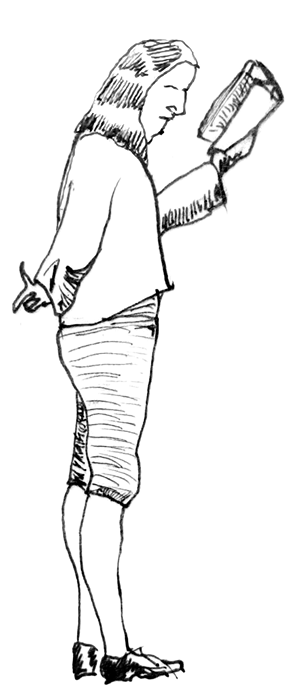
William Smellie, Man-midwife (and Book Collector)
The man behind the book collection was William Smellie, pronounced ‘smyllie,’ (1697-1763), born with average prospects in the southern Scottish town of Lanark. He was apprenticed as a physician, then ran a practice in Lanark for two decades, then moved to London where he specialised in obstetrics and made a name for himself improving the practice of midwifery, saving the lives of mothers and their babies. A biography from 1952 got it right with the title: William Smellie, The Master of British Midwifery (Robert W Johnstone). A copy sits appropriately on the shelf, in the middle of the bookcases surrounded by the 300+ books he himself collected and owned over the years. That evening I jumped onto Ebay, found a copy for a tenner, paid for it and days later here it is, dustcover and all, sitting on my dining room table. It’s a good read. Everything’s in there.
Smellie’s Bequest of his Book Collection
Smellie was educated at the grammar school in Lanark, the county town for Lanarkshire, in south central Scotland, and it was to the school that he bequeathed his library along with £200 for school repairs and to build a library for the books. This bequest was triggered upon the death of his widow Eupham in 1769. Instructions said that no books were to be lent out, specified that two of his chairs along with his reading desk should also accompany the books to the school and that plans for building the library lay with magistrates, church ministers and the schoolmaster. Johnstone says: “…with the lapse of a generation the interest of the trustees was evaporated and both the Library and its contents were allowed to fall into a state of disrepair.” Books perished and some volumes disappeared, and the chairs and desk also went missing. A ‘generation’? Say, by 1800, the collection was falling to pieces.
Fortunes in Recovery
Then 131 years later, in 1931, delegates from an Obstetrics and Gynaecology Conference in Glasgow traveled to Lanark to visit Smellie’s library and were shocked by the state in which they found the books. They kicked up a fuss and in 1934 the collection of books was gathered up and transferred to the town library. Professor Miles Phillips from Sheffield University generously paid for the existing books to be rebound. That’s how we see them today – in excellent condition. And round the same time Lanark Town Council paid for the bookcase which still houses them today. The very bookcase I saw when I entered the secure room on my visit to see the collection. Over time, missing books were returned to the library and restored to their place on the bookshelves. Some found their way home from Ireland. It’s believed only a couple of books are still missing from the original library.
Why is this Collection of Books Interesting?
I dare say most people won’t find a book collection very interesting. But if you think about it, a book collection like Smellie’s has been curated over time and that gives insight into how his life and profession progressed. He bought books as he needed them for his work and for entertainment. So, you get an insight into the owner of the collection. This is all part of learning about someone from the past. Smellie’s collection sits there in those bookcases in that secure room in Lanark Library today, waiting for people to take an interest. I spent two hours looking through a selection of his books and learned more about childbirth than I’ve ever known. And I’m sixty! And in the weeks since my visit his name has popped up in Indexes of books that I own as I prepare other posts for Genius Fan. There’s more to Smellie than meets the eye. See you tomorrow.
Notes
William Smellie, The Master of British Midwifery, RW Johnstone (1952)
Dr. William Smellie and his Contemporaries, A Contribution to the History of Midwifery in the Eighteenth Century, Prof John Glaister (1894) [LINK]
 Genius Fan
Eighteenth century fans: Leave your comments here