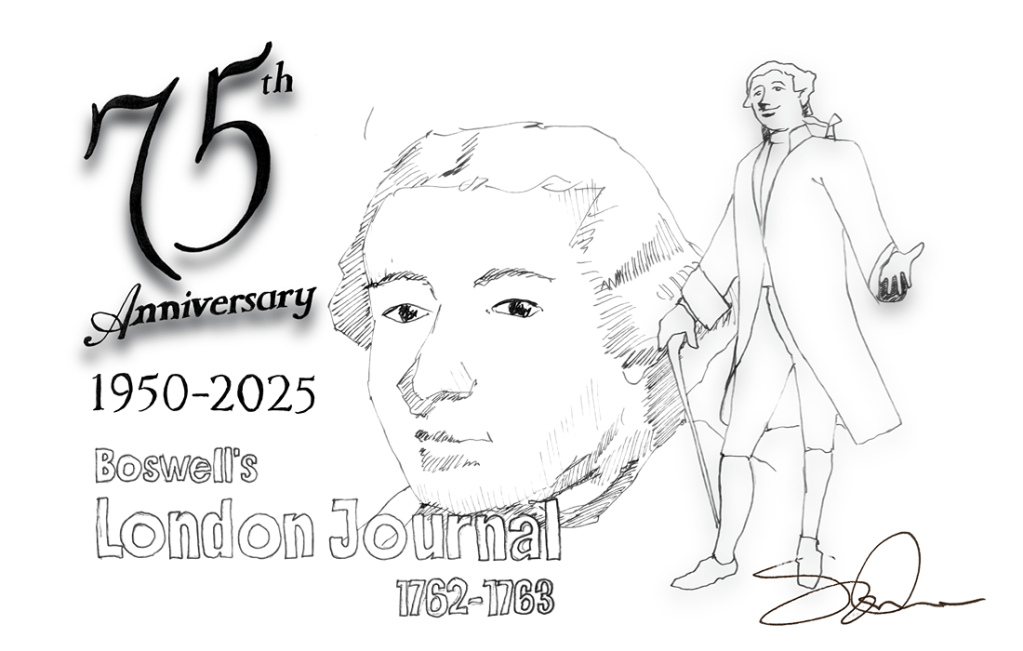
Quote: “The London Journal 1762-1763…is a unique publishing event: the appearance for the first time of a major work by one of the most famous English* authors more than a century and a half after his death.”
(p.xiii, Publishers’ Note, London Journal 1762-1763, Ed. FA Pottle, 1950)
* Note: Boswell may have written in English, but he was nostalgic for Scotland and today he’s considered a famous Scottish author.
Boswell’s London Journal 1762 – 1763 was published on 6 November 1950 in the USA and in 4 December 1950 in the UK, and it became a best seller. Imagine that, tens of thousands of people excited to read a young Scotsman’s diary 188 years after it was written. Can you imagine that same situation in 2025: people today being excited to read a Scotsman’s diary written in 1837? Meh, some might be interested, but would it make onto the Best Selling top 100? I don’t think so.
For me, I’ve read the Journal three times and I enjoy it more upon each new reading. If there’s a plot (can you have a plot in a dairy or journal?) then it’s about Boswell travelling to London to seek a commission in the Guards, despite his father’s preference of a career in the law. Boswell wasn’t particularly interested in soldiering, but he knew the Guards were an elite regiment, they were London-based and they were soon to return victorious from the Seven Years War with no likelihood of returning to war in the near future. Yes, Boswell was pretty calculating. That’s the nearest thing to a plot. I recommend you read the journal and enjoy Bowell’s evocations, his sketches and his inner self as he puts it on paper.
Timeline for Boswell’s London Journal
The book-ends of the narrative are as follows: On Monday 15 November 1762 Boswell set off south from Edinburgh in a coach and horses arriving in London after four nights on the road. He spent nearly nine months in the capital city – mostly socialising it has to be said – the rest was either writing or worshipping. On Saturday 6 August 1763 Boswell, now 22 years of age, travelled to Harwich, accompanied by a new friend, England’s most famous writer, Samuel Johnson and sailed to the Netherlands and then on to Utrecht to study Law.
Boswell’s social circle in London
While he was in London, Boswell did like so many other Scots: he tapped into the network of connections he and his family already had with Scots expatriates. A week after his arrival he was reacquainted with a friend Lieutenant Andrew Erskine and two of his sisters, Lady Anne Erskine and Lady Elizabeth Macfarlane, as well as Jean Dempster, younger sister of Boswell’s friend, newly ‘elected’ MP George Dempster. This group became a regular source of socialising for Boswell, though an entry for 1 December 1762 states: “I was vexed at their coming, for to see just the plain hamely [homely] Fife family hurt my grand ideas of London.” Boswell was always somewhat embarrassed by the accent, rough manners and knockabout humour of his fellow Scots.
There were many other Scots who Boswell socialised with, not least Alexander Montgomerie, 10th Earl of Eglinton, a neighbouring aristocrat from Ayrshire. It was he who introduced the 19-year-old Boswell to the classier pleasures of the Capital during a three month visit in 1760. Boswell got to know the Countess of Northumberland and was invited to attend her society routs at Northumberland House by Charing Cross. Further down the social ladder he mixed often with Thomas Sheridan, actor and elocutionist (and father of Richard Brinsley Sheridan, author of hugely successful play School for Scandal) and he got to know James Macpherson, a Scot controversial for his ‘discovery’ of the Ossian epic Gaelic poems. Hugh Blair, the famous Scots minister sought out Boswell to socialise with in London, and then of course there was his old college friend William Temple from Berwick-Upon-Tweed. When you read the London Journal you’ll realise how many people Boswell socialised with and how many enjoyed his company (read the Journal, you’ll be amazed). Finally, don’t forget, that it was during his stay in London, on 16 May 1763 that Boswell and Samuel Johnson met one another.
Boswell’s sex life in London
I reckon the two things most people know about James Boswell are 1. The Samuel Johnson connection and 2. Boswell’s sex life. This second point is almost certainly one of the reasons the London Journal was so popular when it went on sale at the end of 1950. The journal is littered with descriptions of his ‘whoring’. Now, if you’re interested (everyone is) it all kicks off on Tuesday 14 December with an entry about the free-hearted ladies all around him: ” From the splendid Madam at fifty guineas a night, down to the civil Nymph with white-thread stockings, who tramps along the Strand, and will resign her engaging person to your honour for a pint of wine and a shilling.” Throughout the journal Boswell mentions encounters he has with prostitutes old and young, big and small, merry and sorry, solo or in a pair. And this leads us on to the Covent Garden actress Louisa, who Boswell introduces, also on 14 December, and spends so much time and energy wooing. There are some wonderful descriptions of him trying to get his leg over, worthy of a Brian Rix farce.
It’s this relationship with Louisa (we now know her name is Anne Lewis) that gives Boswell a bout of gonorrhea. On 18 January 1763 he writes: “I this day began to feel an unaccountable alarm of unexpected evil. A little heat in the Members of my body sacred to Cupid very like a symptom of that distemper with which Venus when cross, takes it into her head to plague her votaries.” He had the clap. He’d had it before. This was in fact his third bout. He consulted a family friend physician and confined himself to recover over a number of weeks. He ended the Louisa relationship. This put a temporary stopper on Boswell’s sexual activity, but of his prowess he was very descriptive. William B Ober, in his eye-opening book Boswell’s Clap and Other Essays, says: “…few before the age of Dr. Kinsey and Wilhelm Reich can have bothered to record for posterity the number of their sequential orgasms on given occasions. Pepys and William Hickey sometimes came close to Boswell in erotic frankness, but their enjoyments of the flesh are not, like Boswell’s, a function of the delights of documentation.” Our man spent a lot of energy with prostitutes and it seems he was determined to record his performance.
Boswell meets Samuel Johnson in London
The great outcome of Boswell’s visit to London, something we didn’t have to wait for publication of his London Journal in 1950 to learn about, was the meeting between Boswell and Samuel Johnson. That was already described in Boswell’s hugely successful Life of Samuel Johnson published in 1791. The line all who have read the great biography will know about the Boswell-Johnson meeting is uttered by Russell Street bookseller Thomas Davies, who was hosting Boswell when Johnson turned up unannounced. “Look, my Lord, it comes,” says Davies pointing through a glass door at Johnson shuffling towards them. With the publication of the London Journal, Boswell-Johnson enthusiasts, got a new picture of the meeting, including the description: “Mr. Johnson is a Man of a most dreadfull [sic] appearance. He is a very big man, is troubled with sore eyes, the Palsy & the King’s evil. He is very slovenly in his dress & speaks with a most uncouth voice. Yet his knowledge, and strength of expression command vast respect and render him very excellent company.”
The Boswell-Johnson relationship went from ‘zero to sixty’ in a matter of days, and that’s despite Boswell being a Scot (Johnson was disdainful of the Scots). From that day, Monday 16 May 1763, Boswell and Johnson began spending more and more time in one another’s company. They famously hired a boat to take them down the Thames to Greenwich on Saturday 30 July and this day Boswell is emotional in his account. He describes how, when they set down at Greenwich, he whips out his copy of Johnson’s 1738 poem London and proceeds to “…read the passage on the banks of the Thames, and literally ‘kist the consecrated earth.’” This same day Johnson (53) offers to accompany Boswell (22) to Harwich next Saturday, to catch his boat to Holland. This was not an easy journey to make and involved some hardship, travelling overnight in an uncomfortable coach, and shows Johnson affection for thge young Boswell. We know this, but it’s for another post to look at the friendship between these two. They separated on Saturday 6 August 1763 and didn’t see each other again until 12 Feb 1766.
Notes
London Journal 1762-1763 (by James Boswell), ed. Gordon Turnbull (2010)
London, Samuel Johnson (1738)
The Life of Samuel Johnson, James Boswell (1791)
Boswell’s Meetings with Johnson, A New Count, Hitoshi Suwabe (essay in Boswell, Citizen of the Worlds. Man of Letters. ed. Irma S Lustig (1995)
James Boswell: The Earlier Years 1740-1769, FA Pottle (1966, reissued 1984)
Boswell’s Clap and Other Essays, A Medical Analysis of Literary Men’s Afflictions, William B Ober MD (1979)
Pride and Negligence: The History of the Boswell Papers, FA Pottle (1982)
 Genius Fan
Eighteenth century fans: Leave your comments here